
Voice to Text for Study Notes
Explain It Out Loud and Keep the Notes
The best way to learn something is to explain it. Say the concept in your own words and Voiskey saves the explanation as study notes you can search and review, so active recall leaves a trace instead of vanishing. Free to start.
Explaining Is Studying
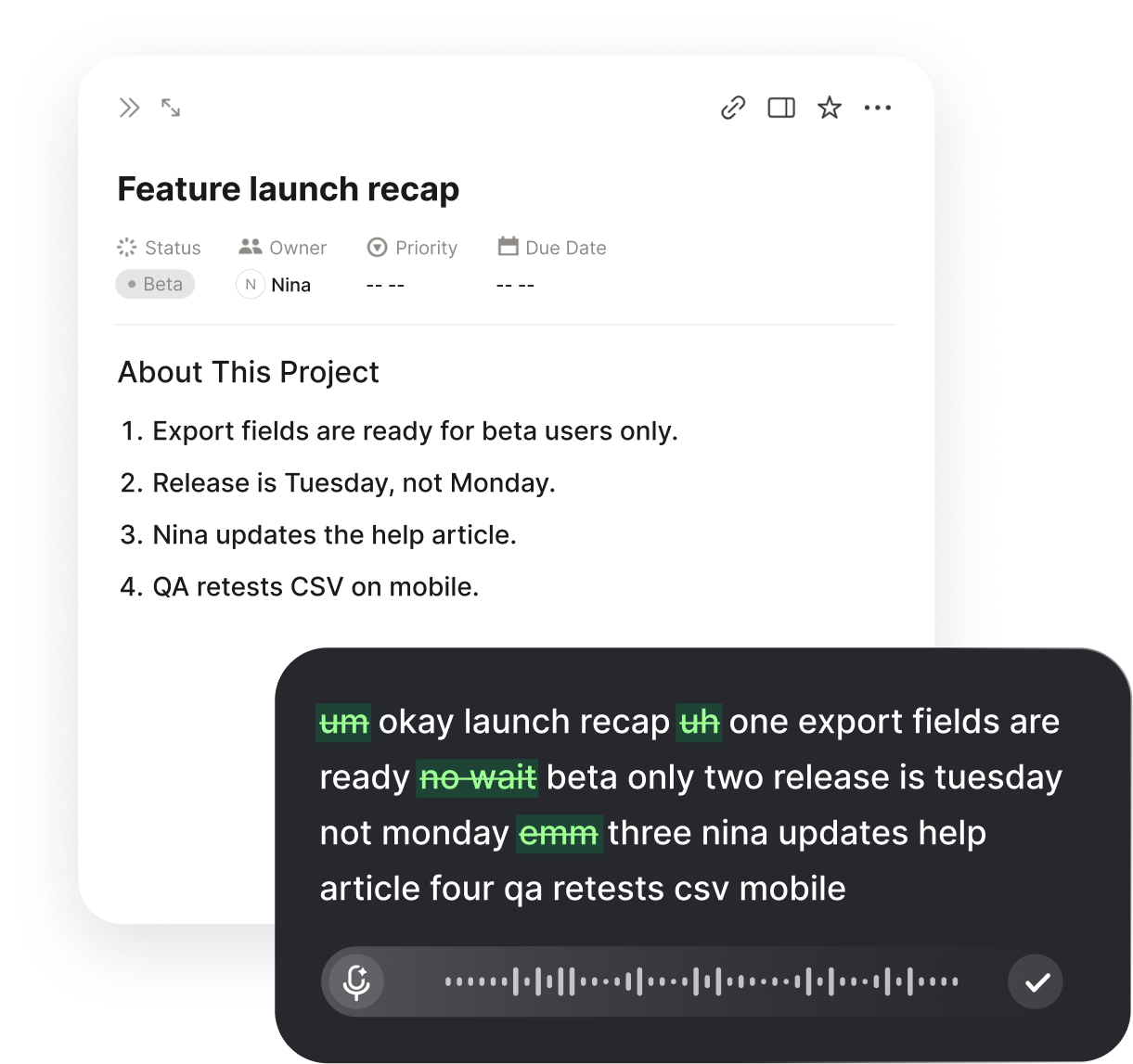
You remember a concept far better after you have put it in your own words. Rereading feels productive because the words look familiar, but recognition is not the same as recall, and the exam asks for recall. Speaking forces you to actually reconstruct the idea, which is where the learning happens.
The bonus is that the spoken explanation becomes a study note automatically, instead of evaporating the moment you close the textbook. You get the memory benefit of teaching the material and a written record of it at the same time, from the same thirty seconds of effort.
Because you talk far faster than you type, capturing an explanation this way costs you almost nothing, so you actually keep doing it.
What Students Dictate
Lecture notes
Voice to text for lectures works best in the gaps around class. Walk out and talk through what actually mattered while it is still fresh. There is no time limit on a session, so a three-hour seminar can come out in one go.
Essay drafts
Dictate an essay the way you would explain it to a friend who is not in your class. Say the messy version, then rearrange the text afterwards. The words are still yours. All you have changed is how they get onto the page.
Reading notes
Talk through a paper's argument as you go, instead of stopping to type a comment every time you have a thought.
Emails to professors and TAs
The message you have been rewriting since Tuesday takes about thirty seconds to say out loud.
Group projects
Updates, handoffs, and the message explaining what you meant in the last message.

Prompts for AI tools
A good prompt is longer than most people want to type, so it gets shortened into something vague. Say the whole thing instead.
A Recall Loop That Leaves a Trace
Read the material once, cover it, then try to explain it out loud from memory. Where you stumble is exactly what you need to review, and speaking makes that gap obvious in a way that silent rereading never does.
Because the explanation lands as editable text, you can compare it against the source and fix the parts you got wrong. Re-dictate the shaky bits, and you have both corrected your understanding and improved the note in one pass.
Speak your way through revision:
- Read the section once, then cover it
- Explain the idea aloud from memory
- Read your note back against the source
- Re-dictate the parts you got wrong
Notes You Can Actually Reuse
Spoken study notes are in your own voice, which makes them far easier to re-read and remember than a definition copied out of a textbook. They already sound like how you understand the idea, so revisiting them the night before an exam feels like a reminder, not a first read.
Search them by keyword to jump straight to a topic, or turn a set of them into quick self-quiz prompts. Voiskey also learns the field-specific terms in your subject, so specialized vocabulary comes out spelled correctly instead of autocorrected into nonsense.
In the Notes App You Trust
Voiskey works wherever you type, so dictate into Notion, Apple Notes, OneNote, or Google Docs, wherever your study material already lives, with nothing to export later. One searchable place for every subject means exam week is a search, not a scavenger hunt.
You do not have to speak up, either. Voiskey picks up softer speech, including a whisper, so you can quiz yourself out loud in a shared room or a quiet corner of the library.
Study tasks worth speaking:
- Concept explanationsVoice typing for notes
- Textbook summariesVoice typing for notes
- Flashcard promptsVoice typing for notes
- Study group recapsVoice typing for messages
Getting Started Is Free
You get one month of Pro free on signup, up to two more months for inviting friends, and 2,000 words a week after that with no expiry. Daily short study-note bursts fit; marathon revision across many subjects uses more.
No .edu address or enrolment check needed. Open your notes app, cover the page, and start explaining what you just read out loud.
FAQ s
Explaining from memory is active recall, which builds retention far better than passive rereading. Rereading feels productive because the words look familiar, but familiarity is not recall, and speaking forces the real thing while keeping a record.
Yes. Dictate a question and answer as text, then move them into your flashcard app of choice, or just cover the answer in your notes to test yourself the next day.
Prose-heavy subjects work great. For formula-heavy topics, dictate the concept and when to use each formula, and type the notation by hand. Voice handles the reasoning, which is most of studying.
Yes. They are plain text, so you can search a term across every subject's notes in seconds and jump straight to the topics you flagged as weak.
Yes. Voiskey learns field-specific vocabulary and your spelling preferences, so specialized terms come out the way you write them instead of being autocorrected.
For most students, yes. A month of Pro free, up to two more for inviting friends, then 2,000 words a week. Daily study-note bursts fit; heavy multi-subject revision uses more.


 Voiskey
Your voice, amplified.
Speak naturally, write effortlessly, and move faster. Turn your voice into polished, ready-to-use text wherever you work.
Use it across macOS, Windows, iOS, and Android