
Seminar Notes: How to Capture Ideas, Not Just Facts
Seminars reward arguments, not transcription. Here is a note structure that tracks who claimed what, why, and what you thought.
 Voiskey Team
Why Seminar Notes Need a Different Structure
A lecture delivers content; a seminar builds an argument. Seminar notes have to capture that argument: the instructor is not the only speaker, the reading is assumed, and the value is in the exchange between positions. Notes that copy facts miss the point of the format.
Seminar notes need to answer different questions: who claimed what, on what evidence, where the disagreement was, and what you thought about it. Those questions produce a record of reasoning rather than a list of definitions.
The pace is also different. Discussion moves in circles, returns to earlier points, and resolves some questions while leaving others open. A chronological transcript is nearly useless; a map of positions is not.
The goal is to leave the room with a sharper version of the debate, not a minute-by-minute account. That means capturing structure while the discussion is happening and compressing it soon afterward.
The note should also record what was not said. A missing counterargument, an unaddressed reading, or a question the group avoided is often the most productive starting point for an essay.
Seminar notes work best when they are written for reuse. The same note should support a class discussion, an essay outline, and an exam answer, which means it needs positions and evidence rather than a summary of who spoke.
A seminar note should also make the reading visible. If the discussion never mentions a passage that seemed central, that absence is worth noting. The gap between what the text emphasizes and what the room discusses is often where the essay question lives, and a note that records only the discussion will miss it.
Capture the Argument, Not the Conversation
The basic unit of a seminar note is the claim, not the sentence. When someone speaks, ask what they are asserting about the text, the evidence, or the question. Write that assertion, then the reason they gave for it.
Do not try to record every turn. Most exchanges are restatements, clarifications, or procedural remarks. Capture the moments where the argument moves: a new claim, a challenge, a concession, or a synthesis.
Use a simple notation. A claim gets a line; a challenge goes under it with an arrow; a concession is marked as such. The notation can be personal, as long as it distinguishes the moves you will need to reconstruct.
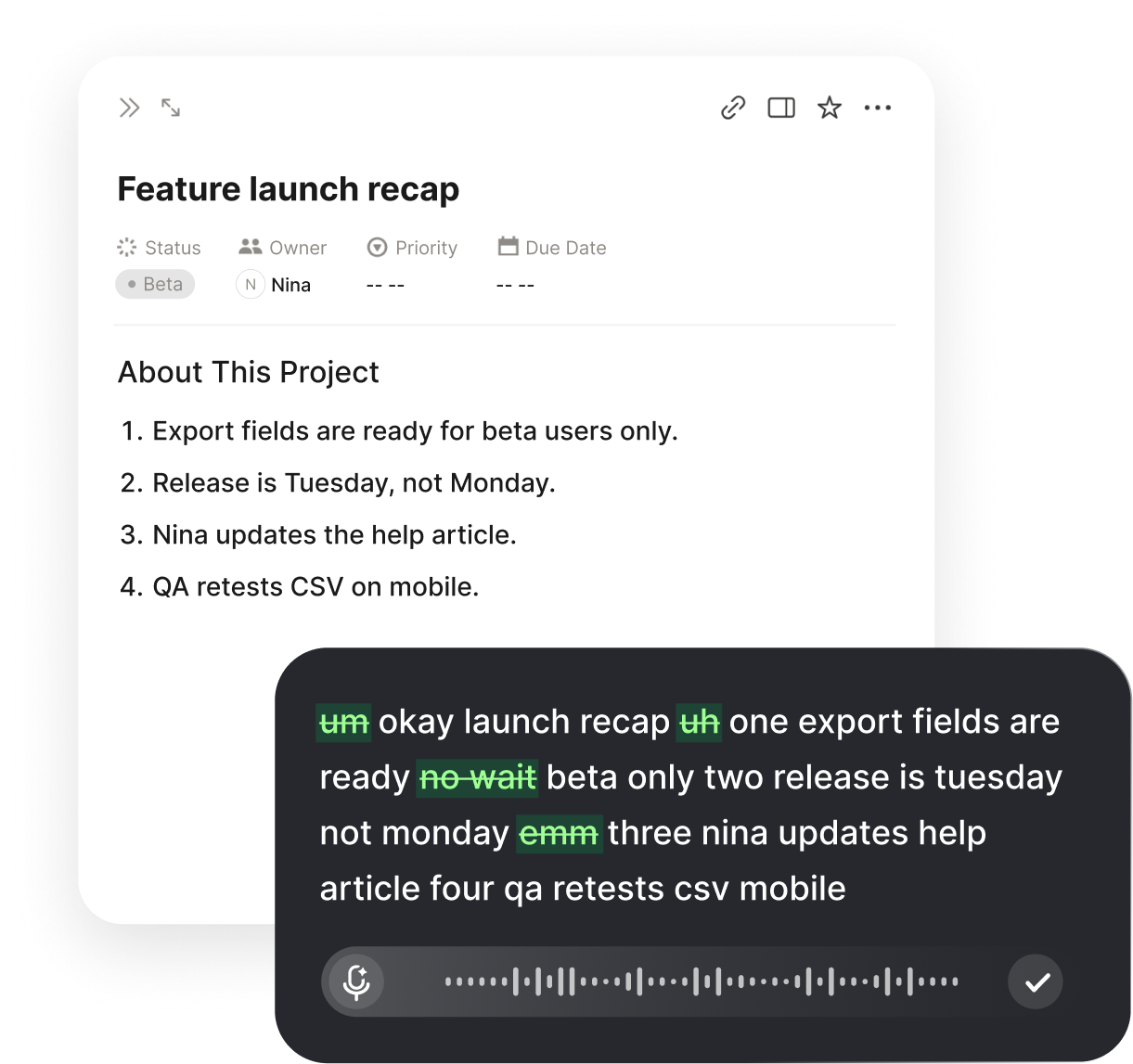
If the discussion is too fast, record it with permission and process the recording afterward. Voiskey transcribes the audio and identifies key points, which gives you a second pass at the parts you could not note live.
If you lose the thread, write the question rather than the last sentence. A question mark is a better note than a misheard claim, and it gives you something to ask when the discussion pauses.
Use the reading's page numbers, not just the speaker's name. Page references let you return to the exact passage when you write the essay, and they keep the note tied to the text.
Write the seminar question at the top before the discussion starts. The question is the anchor for every claim you capture, and it makes it obvious when the conversation has drifted. A note without the question becomes a collection of remarks with no shared subject.
Seminar notes benefit from a simple two-column habit: on the left, what was said; on the right, what you thought while it was said. The left column keeps the record honest, and the right column keeps your own argument alive. Without the second column, a seminar note becomes a transcript with no point of view, which is hard to build an essay from.
Track Speakers, Positions, and Evidence
Attribute claims to speakers. The room argued is not a note; a named person argued that the policy fails on enforcement, citing a specific report, is. Attribution makes the note useful for essays, where the position matters as much as the content.
Separate the position from the evidence. A speaker may hold a strong view with weak support, and the gap between them is often the most examinable part. Note both, even when the evidence is only a page reference.
Mark agreement and disagreement explicitly. A short line connecting two speakers clarifies the structure: who is responding to whom, and whether the response addresses the claim or a side issue.
Keep a running list of unresolved questions. Seminars often end without resolution; the open questions are what the next reading or essay should address. A list at the bottom of the note turns the discussion into a research agenda.
When two speakers seem to disagree, check whether they are answering the same question. Many seminar disagreements are really two answers to different questions, and noting the question resolves the apparent conflict.
Record the evidence quality, not only the evidence. A single case, a small study, and a theoretical argument carry different weight, and the difference is what a good exam answer evaluates.
Attribution is not about fairness; it is about usefulness. When you revise for an essay, you need to know whose argument you are engaging with and what they actually said. A note that flattens everyone into the room makes it impossible to reconstruct the debate.
Record Your Own Reactions While They Are Fresh
Your reaction is part of the note. The seminar is designed to change how you think about the reading, and that change is easy to lose by the next day. Add a short personal section after the positions.
Write what convinced you, what felt weak, and what you would need to check. Do not aim for a polished opinion; aim for an honest first reaction that you can test against the reading later.
Distinguish reaction from evidence. I disagree is a start; I disagree because the sample excludes part-time workers is a note you can use. Push yourself one step past the feeling.
Keep the personal section private if the topic is sensitive or the note is shared. A seminar note can have a public record of positions and a private record of your own response; separating them makes both more useful.
Date your reactions. A reaction written in week two may look naive in week ten, and the change is itself a record of learning. Dated notes let you see how your position developed.
If the seminar is graded on participation, the reaction section also becomes preparation. Reading your last reaction before the next session gives you something specific to say that is not a restatement of the reading.
Do not wait until the end to write the discussion's shape. As the seminar moves, mark where the group agreed, where it split, and where it changed its mind. Those three markers are the skeleton of the essay you will write later, and they are almost impossible to recover from a flat transcript after the fact.
Turn Discussion Into Exam-Ready Themes
After the seminar, compress the positions into themes. A theme is a question the course keeps returning to, with the main positions and the evidence on each side. Three to five themes usually cover a seminar.
Name each theme with the course's vocabulary. If the syllabus calls it legitimacy, do not rename it trust. The exam will use the course's terms, and your note should match them.
Under each theme, write the strongest argument for each position and one weakness. This is the structure of an essay paragraph, and it is also what a good exam answer looks like under time pressure.
Add one sentence linking the theme to the reading. Seminars are built on texts, and a theme without a text is an opinion. The link is what turns discussion notes into course knowledge.
Limit the number of themes. Three to five is enough for one seminar; more usually means the themes are topics rather than arguments. A theme should be contestable, not just a label.
Link each theme to at least one other week's reading. The connections are what turn a series of seminars into a course, and they are what essay questions reward.
Themes should be written as questions, not labels. A label such as legitimacy is a topic; a question such as what makes an institution legitimate is a theme. The question form makes the note easier to test and easier to turn into an essay introduction.
Keep a separate list of quotations worth using in an essay. A seminar often surfaces a phrase or a passage that is more useful than any summary. Copy it exactly, with the page number, and mark who said it and why it mattered.
A Seminar Note Template You Can Reuse
A reusable template keeps the workflow fast. Start with the citation, the seminar question, and the reading. Then add sections for positions, evidence, your reaction, open questions, and themes.
Keep the positions section structured: speaker, claim, evidence, response. Keep the reaction section short and dated. Keep the open questions at the bottom where they are easy to find.
After the seminar, fill the theme section from the positions. This is the compression step, and it should take less than fifteen minutes if the positions were captured well.
Store the template in the app you already use. Voiskey works anywhere you type, so the same structure can be used in a note app or a document, and the note is ready to review when the next seminar asks you to connect the readings.
Keep the template short enough to fill in during the session. A template with twenty fields becomes a form; a template with six sections becomes a tool.
At the end of the term, merge the themes across seminars into a single map. The map is a ready-made revision plan and often reveals the questions the final exam is likely to ask.
FAQ s
Yes. Voiskey records the audio, transcribes it, identifies key points, and structures the notes for review.
It produces structured notes with key concepts, a summary, and exam notes, which you can organize around positions, evidence, and open questions.
Voiskey supports more than 100 languages and can translate, so you can work with seminars in the language they are taught.
Voiskey learns names, jargon, and spelling preferences, which helps keep seminar notes consistent with the course vocabulary.


 Voiskey
Your voice, amplified.
Download Voiskey for Mac or Windows and turn seminar audio into structured notes you can use for essays and exams.
Use it across macOS, Windows, iOS, and Android