
Hand & Wrist Health
RSI From Typing: What It Is and How to Type Less
Type less, recover faster — let your voice carry the load.
What RSI from typing actually is
Repetitive strain injury (RSI) is an umbrella term for pain and dysfunction in muscles, tendons, and nerves caused by doing the same small movements over and over. For people who work at a keyboard, that movement is typing: thousands of tiny finger presses a day, held in the same posture for hours.
RSI is not a single diagnosis. It covers conditions like tendinitis, tenosynovitis, and nerve-related pain that share one root cause — tissue that never gets enough time to recover between bouts of repetitive load. Because it builds up slowly, many people ignore the early signals until typing becomes genuinely painful.
This article is informational and not medical advice. If you already have persistent pain, numbness, or weakness, see a clinician. What follows focuses on one practical lever almost anyone can pull: reducing how much you type each day.
Why repetitive keyboard use causes it
Three factors stack up at the keyboard: repetition, force, and static posture. Every keystroke is low-effort on its own, but a knowledge worker can log tens of thousands of them daily. Add the force some people use to bottom out keys, plus wrists held at an awkward angle, and the load on tendons rarely lets up.
The problem is compounded by continuous sessions. Muscles and tendons recover during rest, but back-to-back emails, documents, chats, and code leave almost no gaps. Over months, micro-damage accumulates faster than the body repairs it — which is how a minor ache becomes a lasting injury.
Early warning signs you should not ignore
RSI usually announces itself quietly: a dull ache in the forearm after a long day, stiffness in the fingers first thing in the morning, or a burning feeling across the wrist that fades overnight at first. Tingling, weakness in your grip, or pain that lingers into the evening are stronger signals.
The pattern matters more than any single symptom. If discomfort shows up earlier each week, takes longer to fade, or starts interrupting sleep, treat it as a sign to change how you work — not to push through. Catching RSI early makes it far more manageable than waiting until typing hurts constantly.
Why reducing keystroke volume speeds recovery
There is no way to heal a repetitive strain injury while repeating the exact motion that caused it at full volume. Rest is the active ingredient, and for typists the most direct form of rest is simply typing less — giving tendons the recovery gaps they have been missing.
You do not have to stop working. Much of a typical day is spent writing things you already know how to say: replies, follow-ups, updates, notes. If a large share of that output moves off the keyboard, your hands get real breaks throughout the day instead of one long uninterrupted load.
Using Voiskey to cut your daily typing
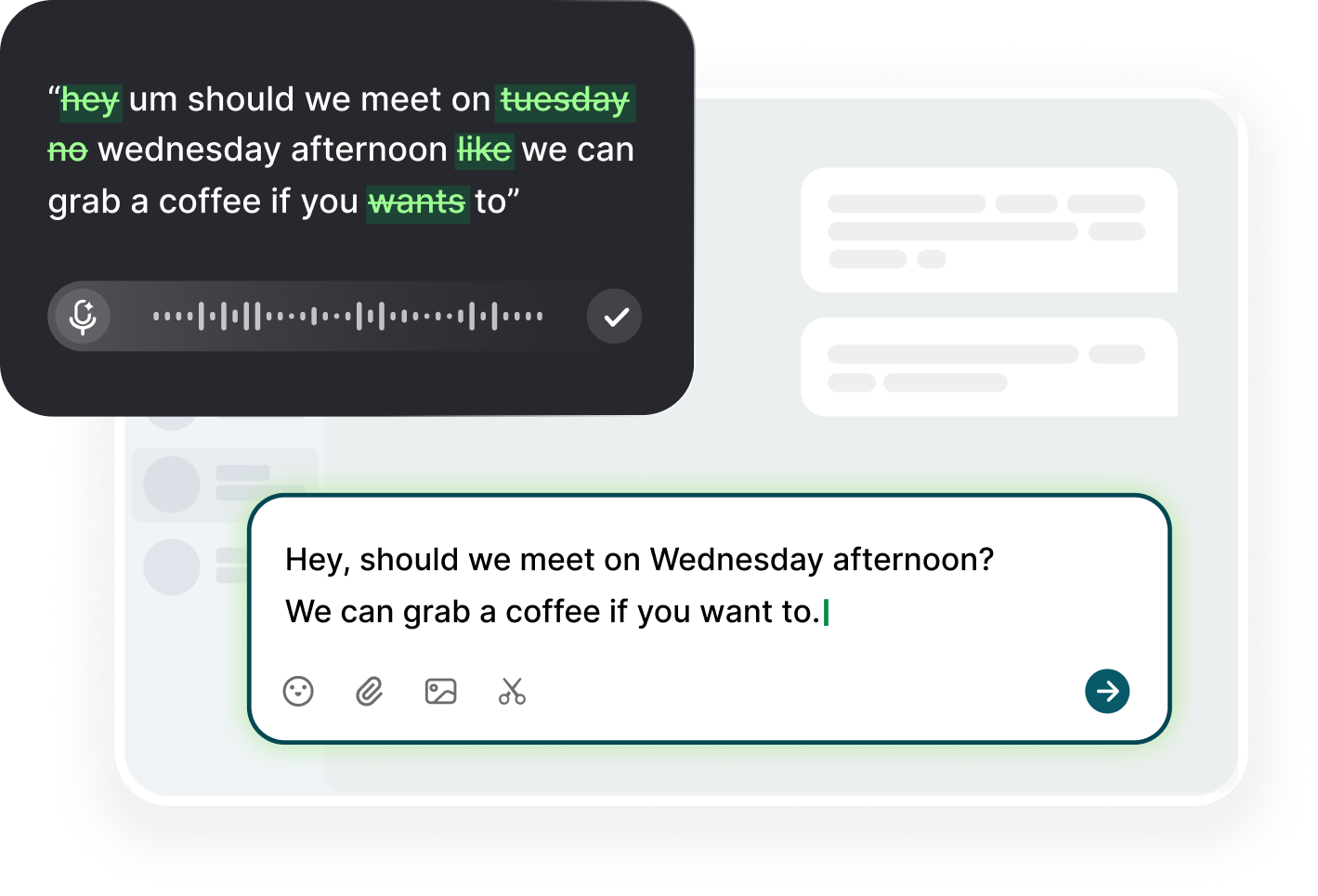
Voiskey is an AI voice typing app that turns natural speech into clean, ready-to-use text wherever you write. Instead of typing an email, message, or note by hand, you speak it — Voiskey removes filler words, fixes punctuation, and shapes the result into a polished draft you review before sending. Speaking runs around 220 words per minute versus roughly 45 for typing, so the same message costs a fraction of the keystrokes.
On your computer: download Voiskey for macOS or Windows, click into any text field, trigger your dictation shortcut, and speak. On your phone: install Voiskey from the App Store or Google Play, add it as a keyboard, then tap into a field and speak. It works across the apps you already use, so you are not moving drafts into a separate window.
Voiskey never sends anything on its own — you always review and send the final text yourself. It supports 100+ languages, and the free plan covers 2,000 words a week, which is enough to shift a meaningful chunk of everyday writing off your keyboard.
Everyday habits and ergonomics that stack with voice
Voice input works best alongside good basics. Set your chair and desk so your forearms stay roughly parallel to the floor and your wrists stay neutral rather than bent up or down. Take short breaks to stretch your fingers and forearms, and step away from the screen periodically.
Think of it as reducing total load from several angles at once: fewer keystrokes through voice typing, better posture through ergonomics, and regular rest through breaks. None of these is a cure, but together they give overworked tissue the conditions it needs to recover — and help keep RSI from coming back.
FAQ s
Voice typing does not treat RSI directly, but it reduces how many keystrokes you make each day. By speaking emails, messages, and notes instead of typing them, you give your hands more recovery time, which is a key part of managing repetitive strain. For persistent pain, see a clinician.
Most people can move a large share of everyday writing — replies, follow-ups, updates, and notes — to their voice, since these are things you already know how to say. Detailed editing or specialized text may still need the keyboard, but the repetitive, high-volume writing is exactly what voice typing handles well.
Yes. Speaking runs at roughly 220 words per minute, while typing averages around 45. For the kinds of messages you write repeatedly, that gap means far fewer keystrokes and less time in a static posture.
Always. Voiskey turns your speech into a draft, then you review, edit, and send it yourself. Nothing leaves your inbox or chat automatically.
No. This article is informational only. If you have persistent pain, numbness, tingling, or weakness, consult a medical professional. Reducing typing is a helpful daily habit, not a diagnosis or treatment.


 Voiskey
Your voice, amplified.
Speak naturally, write effortlessly, and move faster. Turn your voice into polished, ready-to-use text wherever you write.
Use it across macOS, Windows, iOS, and Android