
RSI From Typing
RSI From Typing: Cut the Keystrokes Causing It
RSI from typing rarely shows up overnight; it builds from the sheer number of keystrokes your hands repeat every working day. The most direct way to lower that load is to stop producing so much of your text through your fingers in the first place. Free to start.
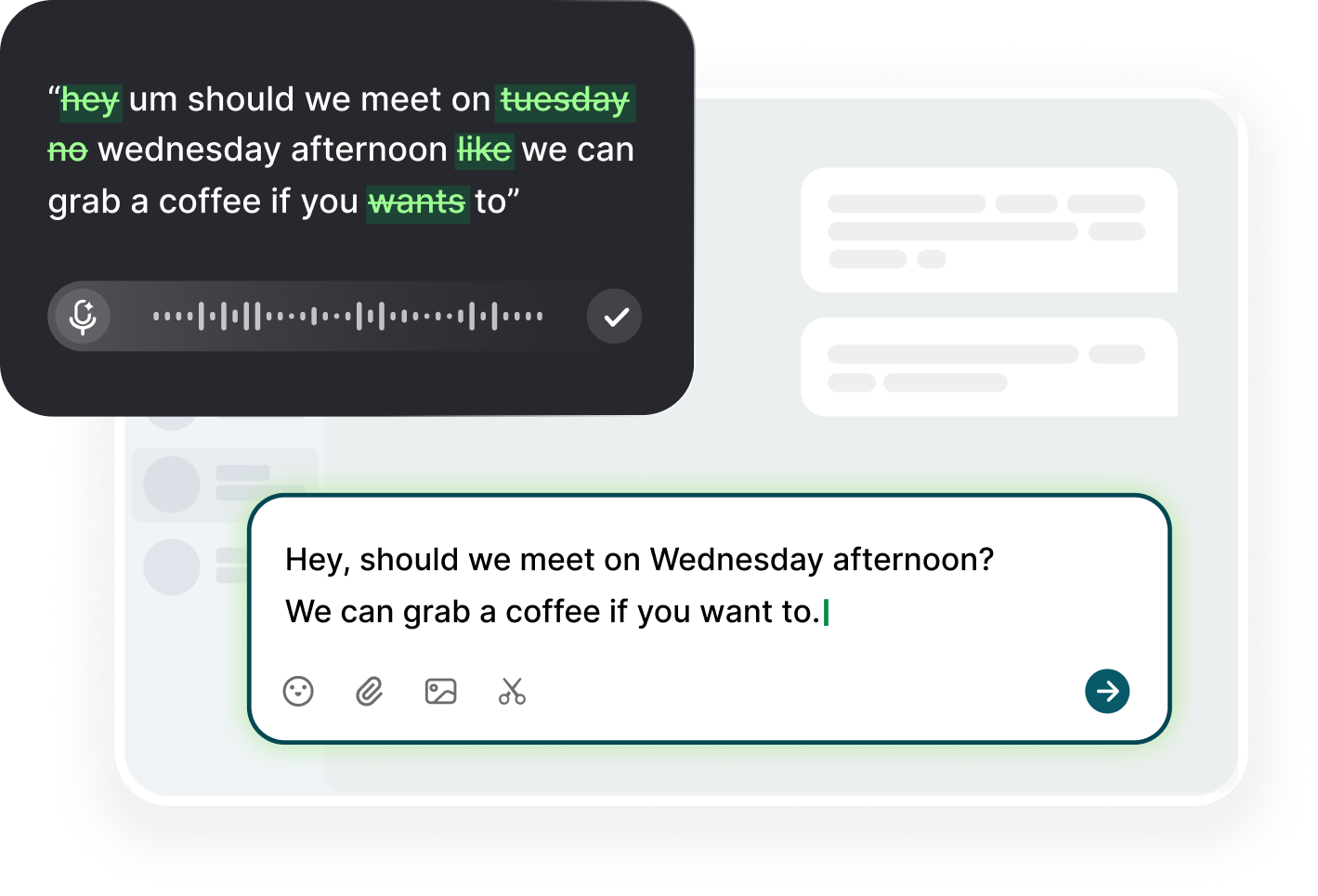
Where RSI From Typing Comes From
RSI from typing is the slow kind of strain that accumulates when your hands repeat the same small movements thousands of times a day, every day, for years. No single keystroke is the problem; it is the sheer total of them. A busy writing job can mean tens of thousands of key presses between morning and evening, each one a tiny load on the same tendons and muscles, with very little variation and even less rest between repetitions.
Volume is the part most people underestimate. A long email is a few hundred keystrokes. A document is a few thousand. A full day of correspondence, notes, tickets, and messages stacks those numbers into something your fingers quietly carry on your behalf. Because the effort of any one key feels like nothing, it is easy to assume the daily total is nothing too, right up until your hands start reminding you otherwise at the end of a heavy week.
The useful insight is that the load is additive and, to a large degree, optional. If most of your words reach the screen because you pressed a key for each letter, then most of your repetitive load is coming from text you could have produced another way. Speaking the same words instead removes that specific source of repetition. You are not working less; you are simply not routing so much of the work through your fingertips.
That is the whole idea behind cutting keystrokes with voice. You keep writing exactly as much as before, but the long-form, high-volume parts of the day leave your hands largely out of it. The keyboard stays for the quick edits and shortcuts where it genuinely is the fastest tool, and the bulk production shifts to a channel that does not depend on repeating the same finger motions over and over.
Who Feels It Most, And When
The people who notice typing load first are usually the ones whose job is mostly words. A support agent clears a queue of long replies before lunch. A developer alternates between code and a steady stream of pull-request comments, docs, and chat. A writer or analyst produces thousands of words of draft a day, then thousands more of edits and email around them. In each case the keyboard is not an occasional tool; it is the one thing their hands do for hours.
The timing tends to be predictable too. Strain shows up at the end of long sessions, on heavy correspondence days, during a crunch when the volume spikes, or in roles where a chat window never really goes quiet. These are exactly the moments when the keystroke count is highest, which is also where moving writing to voice removes the most repetition. The scenarios below are the ones where cutting keyboard volume tends to matter most.
Across all of them the pattern is the same: a predictable block of high-volume text that currently lands entirely through the fingers. Speaking that block instead is where the keystroke savings are largest.
Where cutting keystrokes helps most:
- Clearing a long support or email queueThe day's biggest keystroke block leaves your hands
- Drafting documents, reports, and specsThousands of words produced without the finger load
- Steady chat, tickets, and PR commentsConstant small typing replaced by quick spoken replies
- End-of-day writing when hands are already tiredThe last heavy stretch no longer runs through the keyboard
How to Cut Keystrokes From Typing, Step by Step
You do not reduce your typing load by trying to type less and feeling guilty about it. You reduce it by deciding, deliberately, which parts of your writing day will come out of your mouth instead of your hands, and then making that the default. The goal is to move the highest-volume writing to voice first, because that is where the keystroke savings are biggest, and to leave the keyboard for the places it is genuinely quickest.
Approached this way, the shift is gradual and low-risk. You are not betting your whole workflow on a new tool overnight; you are peeling the single largest source of keystrokes off the keyboard, confirming it works, and then doing the same with the next one. Within a week or two the heaviest writing in your day can be mostly spoken, and the repetitive load that used to pile onto your hands simply is not landing there anymore.
A practical plan to move writing off the keyboard:
- Spot your heaviest typing block. For most people it is email, documents, or chat; whichever one eats the most keystrokes is the first thing to move.
- Install Voiskey as your voice keyboard so it is available in that exact app, with nothing to integrate or configure first.
- Dictate the whole first draft out loud instead of typing it, speaking in plain sentences the way you would explain the point to a colleague.
- Use the keyboard only for small corrections and shortcuts afterward, not for producing the bulk of the words.
- Add the next-heaviest writing task once the first one feels natural, so your spoken share of the day keeps growing.
- Build light habits around it, such as standing up to dictate longer pieces, so the change becomes part of how you work rather than a one-off experiment.
Clean Text Means Less Editing, Not More
A fair worry about voice is that you will just swap typing the words for typing the fixes, and end up pressing as many keys as before. In practice that is not how it plays out, because the first pass is usually clean. Voiskey adds punctuation, handles capitalization, and produces text you can send rather than a raw transcript, so there is far less to go back and repair than people expect.
It also adapts to how you actually write. Voiskey learns names and field-specific vocabulary over time and handles technical terms, so the words you lean on most start landing correctly without you spelling them out. When something unusual does come up, you say it once clearly and glance at the result, the same quick check you would give any first draft, and that small review is nothing compared to typing the entire passage by hand.
The net effect is that editing stays small. You are reviewing and nudging text rather than manufacturing every character of it, which keeps the keystroke count low where it counts. The point of moving to voice is not to trade one kind of heavy typing for another; it is to produce finished-enough text the first time so your hands only handle the light touch-ups.
Works Where You Already Write
Voiskey is a voice keyboard, so it works anywhere you can type, with no integration to set up and no special editor to move into. That matters for reducing load, because the whole point is to cut keystrokes across your real workflow, not to add one more app you dictate into and then copy out of. You speak directly into the document, message, or ticket where the words were always going to live.
It runs on Mac, iPhone, iPad, and Android, and it drops text into Google Docs, Word, Notion, Slack, Gmail, your CRM, and the rest of the tools a writing-heavy day runs through. Because it fits the apps you already use, the places that generate the most typing are exactly the places you can quietly take off the keyboard.
High-volume writing you can speak instead:
- Long emails and repliesDictated straight into Gmail or your mail client
- Documents and reportsSpoken drafts in Docs, Word, or Notion
- Chat and ticket responsesQuick spoken answers in Slack or your CRM
- Notes and quick captureThoughts down without a keyboard, on any device
Getting Started Is Free
You can start cutting keystrokes today without committing anything. Everyone gets one month of Pro free when they create an account, up to two more months for inviting friends, and 2,000 words a week on the free plan after that, with no expiry date. That is enough to move a real chunk of your daily writing off the keyboard and feel the difference before you decide anything.
There is no .edu address to supply and no verification to clear. Create an account, open the app where you do your heaviest typing, and dictate the next thing you were about to type. The simplest way to reduce the repetitive load on your hands is to stop producing so much of your text through them, and the fastest place to prove that to yourself is the very next email in your drafts.
FAQ s
Yes, in a very direct way. Any sentence you speak into Voiskey is a sentence your fingers did not type, so the long emails, documents, and messages that make up most of a writing day stop landing on the keyboard. You still type the odd correction or shortcut, but the bulk volume moves to your voice.
No. This article is general information about reducing repetitive keyboard load and is not medical advice, diagnosis, or treatment. If you have pain, numbness, tingling, or any symptoms you are worried about, please see a qualified healthcare professional, who can assess your situation properly.
People speak at roughly 220 words a minute and type at around 45, so the same paragraph takes a fraction of the time and a fraction of the finger movement. That gap is why voice is such an effective way to shift high-volume writing off the keyboard.
It can. Voiskey learns names and field-specific vocabulary over time and handles technical terms, so the words you use most start coming out right. For anything unusual, say it once clearly and glance at the text, the same quick check you would give any first draft.
No. Voiskey picks up softer speech, including a whisper, so you can dictate at a low volume at your desk without broadcasting your work to the room. Many people find a quiet, close-to-the-mic voice works perfectly well.
Anywhere you can type, with no setup. It runs on Mac, iPhone, iPad, and Android and works inside Docs, Word, Notion, Slack, Gmail, your CRM, and more, so you can cut keystrokes across every tool you already use rather than one special app.


 Voiskey
Your voice, amplified.
Speak naturally, write effortlessly, and move faster. Turn your voice into polished, ready-to-use text wherever you work.
Use it across macOS, Windows, iOS, and Android