
Voice to Text for Research Papers
Get the Research Draft Out of Your Head
You know the study cold. Writing it up is the slog. Speak your methods and findings section by section and Voiskey turns them into draftable text, so the bottleneck stops being the keyboard. Free to start.
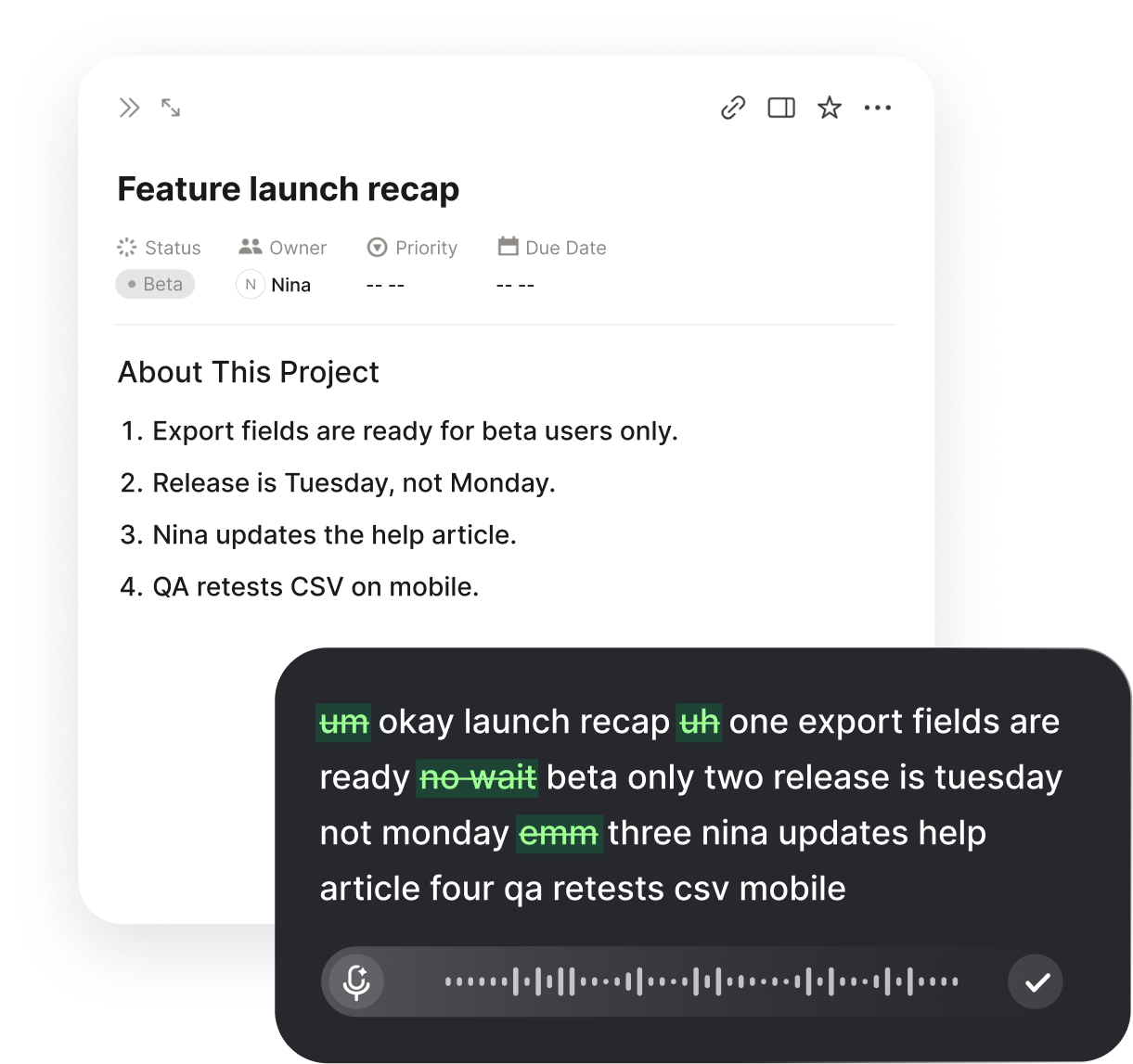
You Know It, Now Write It
By the time you sit down to write the paper, you have lived with the data for months. The bottleneck is not the research. It is transferring what you already understand into formal prose, one careful sentence at a time, while the blank Methods section stares back.
Explaining your methods out loud, as if to a lab mate who missed the last meeting, produces a clearer first pass than forcing academic sentences at a keyboard. You talk at around 220 words a minute against 45 typing, so a section you know cold comes out in minutes instead of an afternoon.
Voiskey learns the field-specific vocabulary and author names in your area, so the terms that fill a research paper come out spelled the way you use them, not autocorrected into something else.
What Students Dictate
Lecture notes
Voice to text for lectures works best in the gaps around class. Walk out and talk through what actually mattered while it is still fresh. There is no time limit on a session, so a three-hour seminar can come out in one go.
Essay drafts
Dictate an essay the way you would explain it to a friend who is not in your class. Say the messy version, then rearrange the text afterwards. The words are still yours. All you have changed is how they get onto the page.
Reading notes
Talk through a paper's argument as you go, instead of stopping to type a comment every time you have a thought.
Emails to professors and TAs
The message you have been rewriting since Tuesday takes about thirty seconds to say out loud.
Group projects
Updates, handoffs, and the message explaining what you meant in the last message.
Prompts for AI tools
A good prompt is longer than most people want to type, so it gets shortened into something vague. Say the whole thing instead.
Draft One Section at a Time
Research papers have a predictable spine, so dictate against it. Speak the methods as the sequence of steps you actually took, in order, then say what you found for results before you worry about how to phrase the significance. The numbers anchor the rest of the narrative.
Save the introduction and abstract for last, once the body exists and you can see what you are actually introducing. Drafting out of order is much easier by voice, because you are just narrating the part you are ready to explain.
Dictate the paper in order:
- Methods: the steps as you performed them
- Results: what the data actually showed
- Discussion: what it means and its limits
- Intro and abstract last, once the body is set
Keep Precision, Skip the Grind
Say your numbers and statistics out loud, then verify them against your dataset before submission. Voice gets the narrative down fast; your eyes confirm the figures. That division of labor is safer than typing everything by hand while tired, when transcription errors creep in anyway.
For equations and specialized notation, type the symbol and dictate the surrounding explanation so the logic stays readable. Voice is for the prose that carries your reasoning, not for the notation, and that is most of a paper.
In Your Manuscript, Not a Side App
Voiskey works wherever you can type, so dictate into Word, Google Docs, or an Overleaf comment and keep your references and structure exactly where they are. Draft in voice, then run your normal citation and formatting passes with nothing lost in transfer.
The same voice handles the advisor update email you keep postponing and the annotation notes you make while reading the literature, so your whole research week runs through one input method.
Paper parts worth speaking:
- Methods walkthroughVoice typing for documents
- Results narrativeVoice typing for documents
- Advisor update emailsVoice typing for emails
- Reading and annotation notesVoice typing for notes
Getting Started Is Free
You get one month of Pro free on signup, up to two more months for inviting friends, and 2,000 words a week after that with no expiry. A section or two fits easily; drafting a full manuscript with revisions uses more across the project.
No .edu address or enrolment check needed. Open your manuscript, pick the section you know best today, and start explaining it out loud.
FAQ s
Yes. Voiskey learns field-specific terms and author names in your area, so most come out right. Say anything unusual clearly and check the text; a quick edit fixes the spelling while the sentence stays intact.
Speak an author-year placeholder while drafting, then insert formatted references in your citation manager during editing. Getting the argument down and formatting the references are two separate passes.
Not immediately, because no first draft is. But you start editing a full section instead of writing it from a blank page, which is the slow part that voice removes.
Type those directly and dictate the explanation around them. Voice is for the prose that carries your reasoning, which is most of the paper, not for notation.
Yes. Voiskey picks up softer speech, including a whisper, so you can draft a section without announcing it to everyone at the next bench.
A section or two fits comfortably in the free plan. Drafting a full manuscript with rounds of revision uses more words over the life of the project.


 Voiskey
Your voice, amplified.
Speak naturally, write effortlessly, and move faster. Turn your voice into polished, ready-to-use text wherever you work.
Use it across macOS, Windows, iOS, and Android