
Prevent RSI From Typing
Preventing RSI From Typing by Speaking Instead
Preventing RSI from typing is far easier than reversing it, and the best time to start is before anything hurts. A voice-first routine keeps your highest-volume writing off the keyboard day after day, so the repetitive load never has the chance to pile up. Free to start.
Why Preventing It Early Beats Fixing It Later
Preventing RSI from typing is about lowering the repetitive load your hands carry before it ever has a chance to build into a problem. The strain that comes from a keyboard is cumulative: it is not one hard day but thousands of ordinary ones, each adding a little more to a running total of small, identical finger movements. The sensible moment to act on that total is while it is still low, not after it has climbed high enough to notice.
The trouble is that a keyboard day feels effortless key by key, so there is rarely an obvious signal to change anything. People wait for a reason, and the reason that eventually arrives is usually discomfort, which is exactly the thing a prevention habit is meant to avoid. Acting early means you do not need that signal; you simply decide that your heaviest writing will not run through your fingers, and you set it up that way from the start.
A voice-first routine is the practical form of that decision. Instead of typing every email, document, and message and hoping the volume stays manageable, you speak the high-volume parts by default and keep the keyboard for the light, precise work. The load you remove is load that never accumulates, which is what makes speaking such a straightforward prevention strategy rather than a last resort.
Nothing about this requires working less or slowing down. You produce the same output, often faster, but a large share of it arrives as speech rather than keystrokes. The rest of this article lays out when to speak during a normal day and how to turn those moments into a routine that sticks.
The Daily Moments Worth Speaking
Prevention works best when it is attached to specific, recurring moments rather than a vague intention to type less. The good news is that a normal working day is full of them. The morning inbox is a wall of replies waiting to be typed. The afternoon is drafts and documents. The gaps in between are a steady trickle of chat and short messages. Each of these is a predictable block of writing you can decide, in advance, to speak.
Choosing those moments ahead of time is what turns prevention from a one-off into a habit. When you know that the morning email clear-out is a dictation task, you do not have to decide again each day; the keyboard simply stops being the default for that block. The scenarios below are the recurring moments where speaking first keeps the most volume off your hands over a week.
The through-line is that these are not rare, special tasks. They are the ordinary, repeated writing that fills most days, which is precisely why moving them to voice has such a steady, preventative effect.
Recurring moments to speak instead of type:
- The morning inbox clear-outThe day's first big typing block becomes a spoken one
- First drafts of documents and reportsLong-form writing arrives as speech, not keystrokes
- Chat, comments, and quick repliesThe all-day trickle of small typing moves to voice
- Notes and capture on the moveThoughts recorded without reaching for the keyboard
How to Build a Voice-First Routine, Step by Step
A routine sticks when it is simple and tied to things you already do. You are not trying to overhaul your whole workflow; you are inserting a single new default, which is to speak the heavy writing before you type it. Build it one block at a time so each step feels natural before you add the next, and let the keyboard keep the small, precise jobs it does best.
Done this way, the routine grows quietly in the background. Each block you move is a permanent reduction in daily keystrokes, and because you add them gradually there is never a disruptive switch-over day. After a few weeks the voice-first default covers most of your heavy writing, and keeping the load low stops being something you think about and becomes simply how you work.
A routine you can start this week:
- Pick one daily writing block to speak first, such as the morning inbox, and make dictation its default from now on.
- Install Voiskey as your voice keyboard so it is ready in that app with nothing to integrate or configure.
- Each morning, dictate that block out loud in plain sentences before you touch the keys for it.
- Keep the keyboard only for quick edits and shortcuts, so your fingers handle the light work rather than the bulk.
- Add a second block, like document drafts or afternoon chat, once the first feels automatic.
- Review weekly which parts of your day are still mostly typed, and move the next-heaviest one to voice.
Clean Drafts Keep the Edits Light
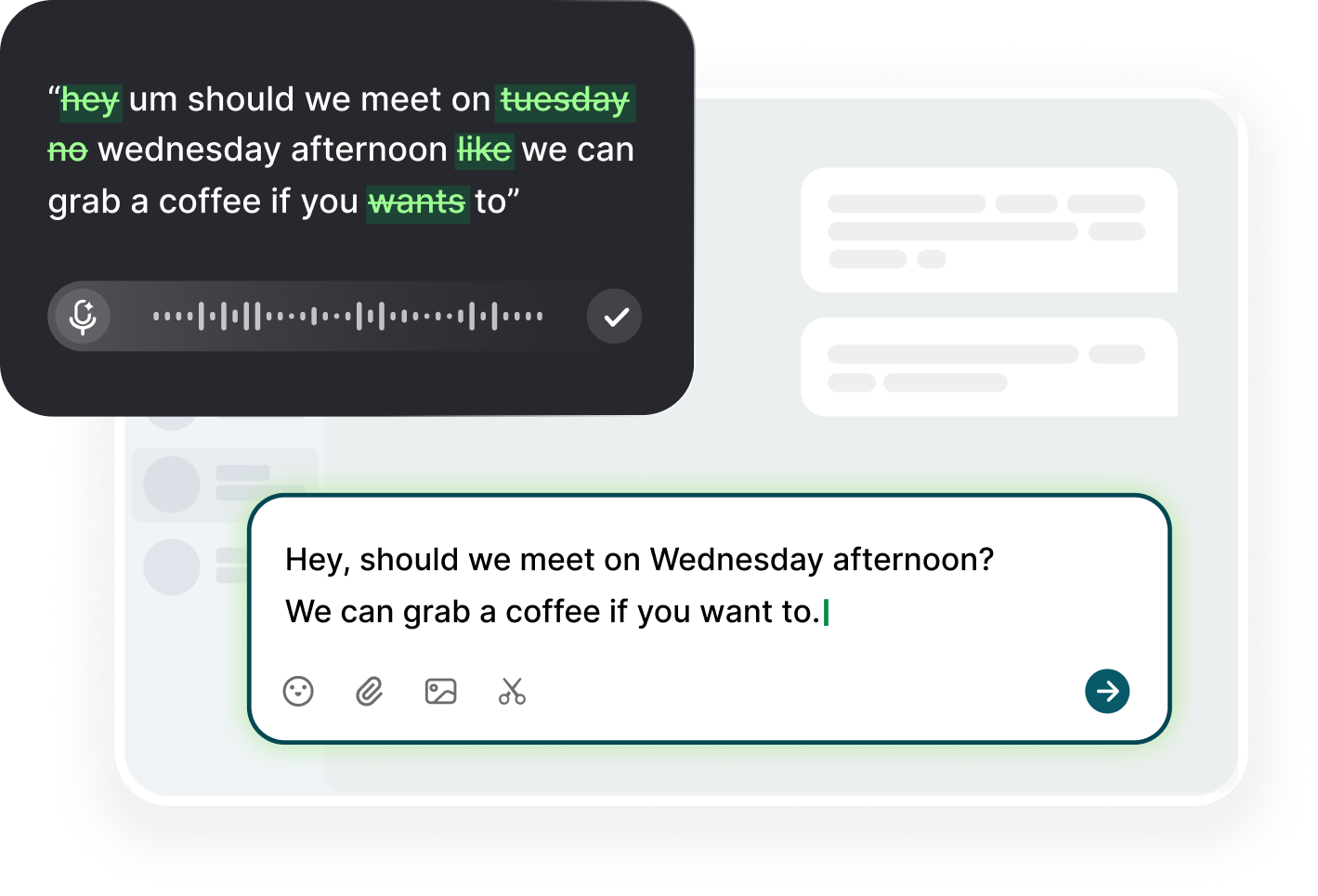
For a prevention routine to actually lower your keystrokes, the dictated text has to come out clean enough that you are not retyping it afterward. That is where it holds up. Voiskey adds punctuation, handles capitalization, and gives you text you can send rather than a raw stream of words, so the first pass is usually close to finished and the editing stays light.
It also gets better the more you use it. Voiskey learns names and field-specific vocabulary over time and handles technical terms, so the language particular to your work starts landing correctly on its own. When something unfamiliar comes up, you say it once clearly and glance at the screen, a quick check rather than a rebuild, which keeps the keyboard touch-ups to a minimum.
That matters because the whole point of the routine is fewer keystrokes, not a different set of them. If dictation produced messy text you had to repair by hand, you would simply be moving the load around. Because the drafts are clean, your fingers only handle the final polish, and the preventative benefit of speaking the bulk actually holds.
Fits the Tools You Already Use
A routine only lasts if it fits your real day, and Voiskey is built to do exactly that. It is a voice keyboard, so it works anywhere you can type with no integration to set up, which means your voice-first habit lives inside the apps you already work in rather than in a separate window you have to copy out of. You speak straight into the email, doc, or message where the words belong.
It runs on Mac, iPhone, iPad, and Android and drops clean text into Google Docs, Word, Notion, Slack, Gmail, your CRM, and the other tools a writing day flows through. Because the routine attaches to the apps you already open, the moments you planned to speak are available everywhere, and the keyboard volume you are trying to prevent drops across the whole day rather than in one isolated place.
Where a voice-first routine lives:
- Email and inboxSpoken replies in Gmail or your mail app
- Documents and long draftsDictated into Docs, Word, or Notion
- Chat and team toolsQuick spoken messages in Slack or your CRM
- Mobile captureNotes by voice on iPhone, iPad, or Android
Getting Started Is Free
You can set up a voice-first routine today at no cost. Everyone gets one month of Pro free when they create an account, up to two more months for inviting friends, and 2,000 words a week on the free plan after that, with no expiry date. That is more than enough to move your heaviest daily writing block to voice and let the habit take hold before you decide anything.
There is no .edu address to supply and no verification to clear. Create an account, open the app where your morning writing happens, and dictate the first block instead of typing it. Preventing the slow build-up of repetitive load is really just a decision made early and repeated daily, and the easiest place to make it is the very next thing you were about to type. Start with one block tomorrow morning, keep it as your default for a week, and let the routine prove itself before you move anything else across.
FAQ s
Because a routine is far easier to build when you are not under pressure. If you make speaking your default for high-volume writing while your hands feel fine, the habit is already in place on the heavy days when the keystroke count would otherwise spike. Prevention is simply moving load off the keyboard before it accumulates.
No. This article is general information about building a lower-keyboard-volume routine and is not medical advice, diagnosis, or treatment. If you have pain, numbness, tingling, or other symptoms, please consult a qualified healthcare professional, who can give you guidance based on your own situation.
More than most people expect. Speaking runs at roughly 220 words a minute against about 45 for typing, so long emails, drafts, notes, and messages are quick to say out loud. Those categories tend to make up the bulk of a writing day, which is exactly the volume a voice-first routine is designed to shift.
Yes. Voiskey learns names and field-specific vocabulary over time and handles technical terms, so the words you use most come out right without constant correcting. Say anything unusual once clearly and check it, the same quick glance you would give any draft before sending.
You can. Voiskey picks up softer speech, including a whisper, so a low voice close to the mic is enough in a shared office or at home. You do not need to raise your voice or find a private room to make the routine work.
Anywhere you can type, with no setup. It runs on Mac, iPhone, iPad, and Android and drops text into Docs, Word, Notion, Slack, Gmail, your CRM, and more, so your voice-first routine fits the tools you already use instead of forcing you into a separate app.


 Voiskey
Your voice, amplified.
Speak naturally, write effortlessly, and move faster. Turn your voice into polished, ready-to-use text wherever you work.
Use it across macOS, Windows, iOS, and Android