
1:1 Meeting Notes: What to Capture and What to Skip
A 1:1 is a thread, not a transcript. Here is what to write down, what to leave out, and how to make the next conversation build on this one.
 Voiskey Team
What Makes 1:1 Notes Different
A 1:1 is not a status meeting with fewer people. Good 1:1 meeting notes connect a conversation about work, priorities, blockers, and growth to the next one; the job is not to record every sentence.
The audience is also different. A 1:1 note is usually private, shared at most between two people. That privacy changes what belongs in the note: sensitive context can be captured, but it should not leak into a shared team document.
The cadence matters. A weekly or biweekly 1:1 produces a long series of small notes, and the value comes from the thread between them. A note that stands alone loses the history that makes the conversation useful.
The best 1:1 notes are short. They carry commitments, blockers, and themes forward, and they leave out the play-by-play that neither person will reread.
A 1:1 note also has a different failure mode. A status note can be long and still useful; a 1:1 note that is long usually means the conversation drifted into reporting and the important topics were squeezed.
The best test of a 1:1 note is whether it makes the next conversation easier. If you would not want to open it before the next meeting, it is too long, too vague, or too guarded.
A 1:1 note is also a record of your own management. Reading a month of notes shows whether you are giving enough context, whether commitments are realistic, and whether the same blocker keeps returning. That reflection is easier with a short running note than with memory.
The note should also record what was decided not to discuss. A topic that both people agreed to defer is a decision, and it prevents the same item from reappearing as a surprise in a later meeting.
Prepare a Running Agenda Before the Meeting
Keep a running agenda between meetings. When something comes up that belongs in the 1:1, add it to the list. The agenda grows between sessions, so the meeting starts with what actually matters.
Put the last note at the top. Review the commitments from the previous meeting before adding new topics. This turns the 1:1 into a follow-up conversation rather than a fresh start every time.
Separate the agenda into three sections: updates, blockers, and growth. Updates are short; blockers need decisions; growth needs time. The structure protects the growth conversation from being crowded out by status.
Share the agenda before the meeting if that is the norm between you. A shared running document makes the preparation mutual and reduces the chance that an important topic appears only at the end.
Keep the agenda in the same document as the notes. A separate agenda and a separate note create two places to look, and the one you forget is usually the one with the commitment.
If the other person prefers to add topics directly, give them access to the agenda. A shared list reduces the surprise topics that appear only in the final minutes.
The running agenda should not become a backlog. If a topic has been on the list for three meetings, either make time for it or remove it. A list that only grows teaches both people that the agenda is decorative.
If the other person brings a topic that is not on the agenda, add it rather than deflect it. The running list is a tool for continuity, not a gate. The note should show that the conversation had room for what mattered in the moment.
Send the 1:1 note to the other person after the meeting, even when it is short. The send is a check: if the note misrepresents what they said, they can correct it while the conversation is fresh. A note that is never shared is a private interpretation, and private interpretations drift.
Capture Commitments and Blockers
Capture commitments in the same one-line format used for any action: verb, object, owner, date. In a 1:1, the owner is usually one of the two people in the room, and the date is usually the next meeting.
Capture blockers with the dependency named. Waiting on legal is less useful than waiting on legal review of the vendor contract, expected Thursday. The detail determines whether the next meeting can unblock it.
Distinguish a blocker from a complaint. A blocker has a specific next step; a complaint is context. Note the context briefly if it affects the work, but do not turn the note into a diary.
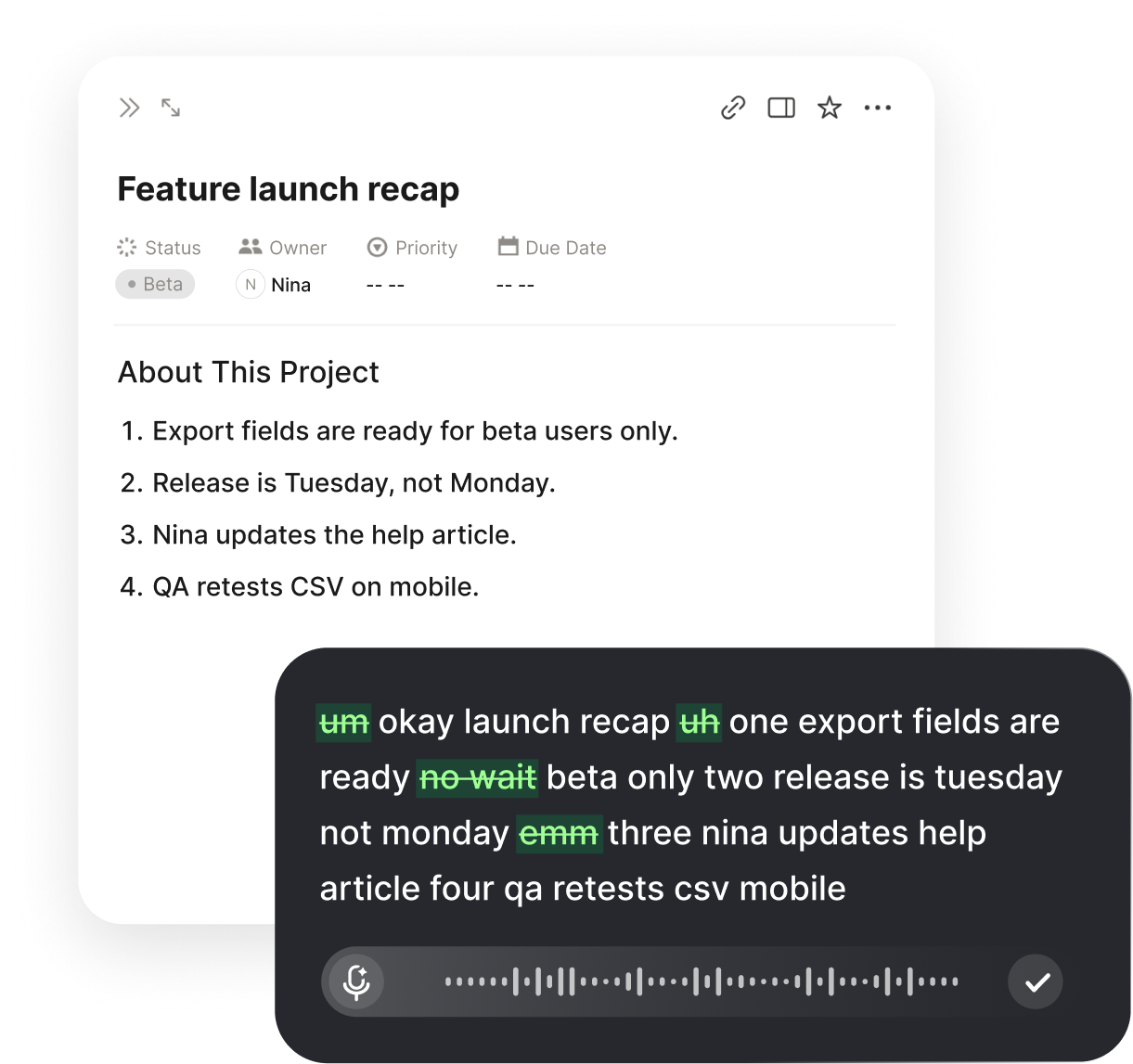
If the conversation is recorded with permission, Voiskey can transcribe it and identify key topics. That is useful for catching a commitment you missed, but the note should still be written in the meeting while the intent is clear.
Write commitments in the language the person used. A paraphrase can change the scope, and the owner will remember their own words more reliably than your summary.
If a blocker has been open for several meetings, name the pattern. Recurring blockers are often a sign that the work needs a different owner or a different plan, not another reminder.
Track Feedback and Growth Themes
Feedback is easy to lose because it often arrives as a comment, not a headline. Note the specific observation, the context, and what the person plans to try next. Specificity is what makes feedback actionable.
Track themes across several meetings. A single comment is a data point; three comments about the same pattern are a theme. The running note is where that pattern becomes visible.
Record growth topics separately from performance judgments. Wants more ownership of planning is a topic; needs to improve is a judgment. The first can be worked on, the second usually shuts the conversation down.
Revisit the themes on a regular cadence, not every week. Monthly or quarterly is often enough. The note should show progress against the theme, not repeat the same observation.
Ask for permission before writing down sensitive feedback. A note that captures a raw comment can do damage if it is read later without the context of the conversation.
Separate what was said from what you concluded. The observation belongs in the note; your interpretation belongs in a private reflection, not in the shared record.
Feedback should be recorded with the next step, not just the observation. A comment without a follow-up becomes a judgment; a comment with a specific experiment becomes coaching. The note should show what the person will try before the next meeting.
Keep a separate list of topics you owe the other person and topics they owe you. The two lists should be visible at the top of the running note, because the relationship is a two-way exchange and a note that only tracks your agenda quietly turns the meeting into a status report.
Keep the Notes Private and Useful
Decide the sharing boundary at the start. Some 1:1 notes are private to the manager; some are shared with the direct report; some are shared more widely. The boundary should be explicit so both people know what will be written down.
Keep sensitive personal detail out of shared documents. If the conversation touches health, family, or a conflict, note only what is needed to follow up and keep the detail in a private place.
Write for the next conversation, not for an audit. The note is a tool for continuity, and a short, honest record is more useful than a comprehensive one that nobody wants to reopen.
Review the note before sharing it. Remove speculation, attribute observations rather than motives, and check that the commitments are accurate. A 1:1 note that misquotes a commitment damages trust quickly.
Tell the other person what you keep and why. A transparent note practice builds trust; a hidden one creates suspicion, even when the content is benign.
Review the note before the next meeting and delete what is no longer relevant. A 1:1 note is a working document, not an archive of every remark.
Agree on what happens to the notes when the relationship ends or the manager changes. A clear retention and handover rule protects both people and prevents old notes from resurfacing without context.
A short note is easier to keep honest. Long notes invite speculation because there is space to fill. Keeping the record to commitments, blockers, and themes reduces the temptation to write things neither person would stand behind.
Start the Next 1:1 With the Last Note
Open the next meeting with the previous commitments. What was done, what slipped, and what changed? This takes five minutes and signals that the conversation has continuity.
Carry forward the open blockers and growth themes. Do not re-litigate closed topics. A running note with dates makes it clear what is current and what is history.
Add the new topics from the running agenda. Keep the same three sections: updates, blockers, growth. The stable structure makes the conversation faster to prepare and easier to follow.
Voiskey works across macOS, Windows, iOS, and Android. To use it for 1:1 notes, open the official website and click the download button in the top right corner, then record with permission if both people agree.
If a commitment slipped, discuss the cause before the next commitment. A 1:1 is the right place to adjust workload or priorities, and the note should show that the adjustment happened.
Keep a short list of open growth topics at the bottom of the note. The list is the thread across meetings, and it prevents the same topic from being rediscovered every quarter.
When a topic keeps reappearing without progress, write down why. The reason is usually a missing decision, a missing resource, or a missing owner, and naming it turns a recurring complaint into a problem with a next step. The note should show the reason, not just the repetition.
FAQ s
Yes. Voiskey records the meeting audio, transcribes it, identifies key points, and structures the notes.
It produces structured notes with a summary, decisions, and action items, which you can trim to what belongs in a shared record.
Voiskey is available on macOS, Windows, iOS, and Android, and it works anywhere on your computer.
Voiskey supports more than 100 languages and can translate, so you can use it for 1:1s held in another language.


 Voiskey
Your voice, amplified.
Download Voiskey for Mac or Windows and turn 1:1 audio into structured notes with commitments, blockers, and follow-ups.
Use it across macOS, Windows, iOS, and Android