
Voice to Text for Multilingual Email
Translate Client Email Without Writing It Twice
Client email fails when tone dies in translation. Say the reply once—Voiskey turns it into text that still sounds like you. Free to start.
The Language Tax on Every Reply
Cross-border email has a hidden tax: you draft in your strongest language, paste into a translator, then rewrite until it sounds human again.
That loop is why replies sit in drafts. The thinking was done; only the translation layer was left.
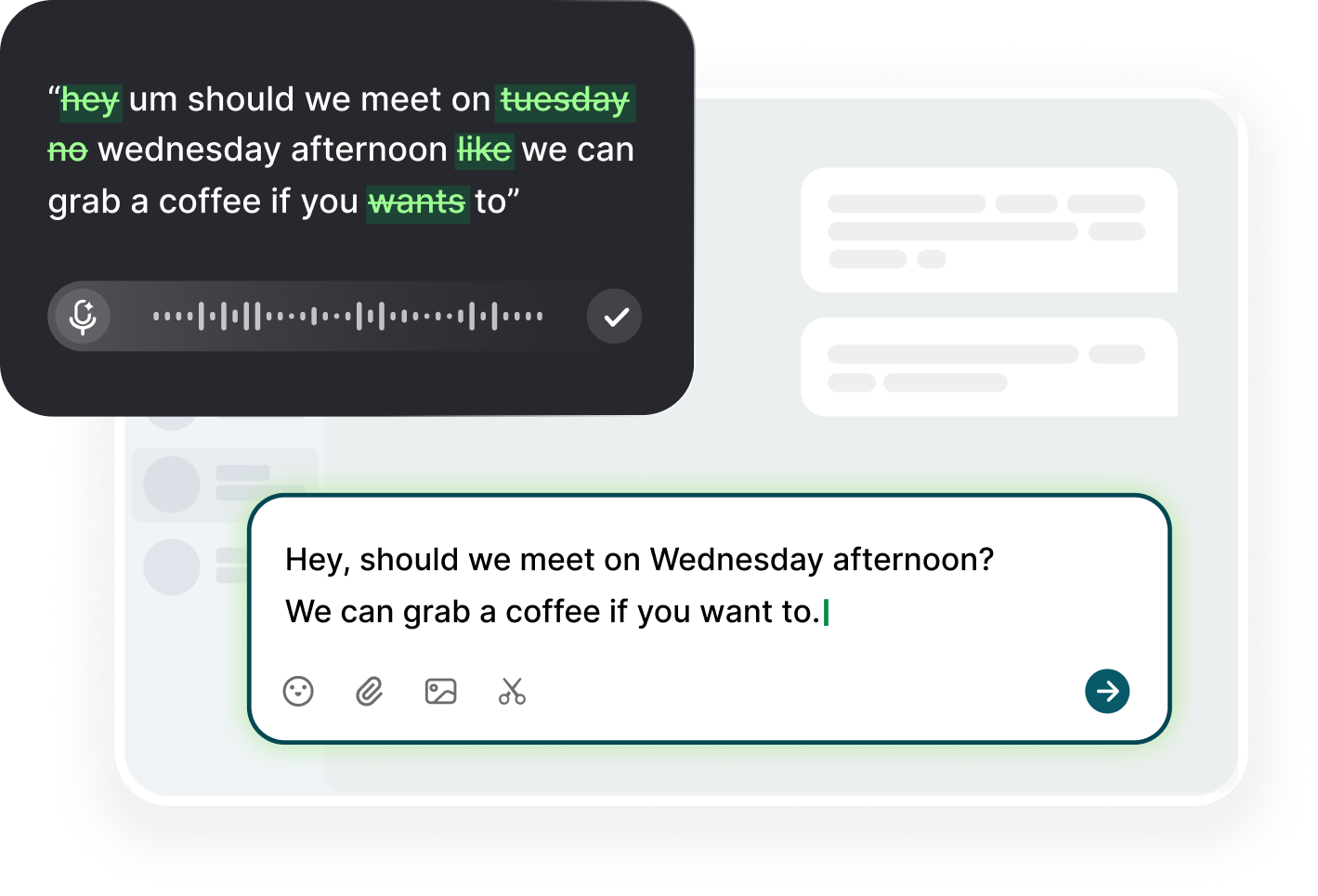
Voice typing for translation cuts the loop. You speak the intent, get readable text in the target language, and edit the few lines that still need your judgment.
Across 100+ languages, the win is not novelty—it is clearing the queue before the next call starts.
A Simple Inbox Translation Workflow
Open the thread. Select the languages you use with that client set. Speak the reply the way you would explain it to a colleague.
Voiskey cleans fillers and shapes register so the email does not arrive as a literal swap. Names and numbers still need your eyes.
If auto-detect keeps choosing the wrong language mid-week, drop to a shortlist of two. Translation quality improves when the model is not guessing across the entire 100+ languages catalog.
Send from the same inbox you already live in. The translation step should not invent a new tool chain.
Email translation checklist:
- Select the client’s language (and yours if you code-switch)
- Dictate the reply in one continuous pass
- Check names, dates, money, and commitments
- Send from the original thread—no re-paste
Emails Worth Dictating Across Languages
Same-Day Follow-Ups
The thank-you and next step while the meeting is still warm—in their language.
Professional Client Notes
Formal enough for procurement, clear enough that nothing gets lost in translation.
Quick Status Replies
Short answers that used to wait for a keyboard layout you do not use daily.
Work Updates
Weekly progress for a stakeholder who reads a different language than your team Slack.
Founder Customer Email
Direct founder voice, translated without becoming corporate filler.
Creator Audience Mail
Newsletter-style notes when your audience spans more than one language market.
Tone and Register Still Matter
Translation fails when every language gets the same formal paragraph. A French client and a Brazilian partner do not want identical stiffness.
Speak the way you would on a call. Voiskey aims for natural order and everyday phrasing so the result feels written in that language, not exported into it.
Regional spelling is part of trust. British English, Swiss German orthography, Simplified versus Traditional Chinese—pick the variant your reader uses.
If a phrase still feels off, say it again with the register you want. The second pass is cheaper than a bad send.
Where the Text Lands
Gmail, Outlook, HubSpot sequences, LinkedIn InMail—anywhere a cursor blinks. Multilingual email translation does not need a plugin if dictation works at the keyboard.
On mobile, the same workflow covers airport replies. You do not wait until you are back at a desk with the right input method installed.
Keep 100+ languages available in the product; keep two or three active for the accounts you serve this quarter. That is how translation stays fast without getting noisy.
Workflows for a multilingual inbox:
- Client and stakeholder emailVoice typing for emails
- LinkedIn and WhatsApp follow-upsVoice typing for messages
- Account notes after the callVoice typing for notes
- Internal translation of the askVoice typing for teams
- Recap emails after meetingsVoice typing for meetings
FAQ s
Yes. Click into the compose box, speak, and the text lands where you were about to type. Outlook, Superhuman, and other inboxes work the same way because Voiskey runs at the input level.
You keep the languages you actually write in selected. Voiskey supports 100+ languages and 20+ keyboards, so a Spanish client reply and a French follow-up do not require switching system keyboards or opening a translator tab.
They should not. The goal is phrasing that reads written, not pasted. You still skim for names, numbers, and promises before you hit send.
Speak in whichever language the sentence comes to you in, then review the German output. For high-stakes threads, keep German selected as the session language so detection stays stable.
Short replies and follow-ups often fit two thousand words a week. Long proposals in a second language use the allotment faster—upgrade when that becomes the daily default.


 Voiskey
Your voice, amplified.
Speak naturally, write effortlessly, and move faster. Turn your voice into polished, ready-to-use text wherever you work.
Use it across macOS, Windows, iOS, and Android