
Meeting Action Items: How to Write Notes With Owners and Deadlines
Meetings fail in the follow-up, not the discussion. Here is how to end every meeting with an action list that survives the week.
 Voiskey Team
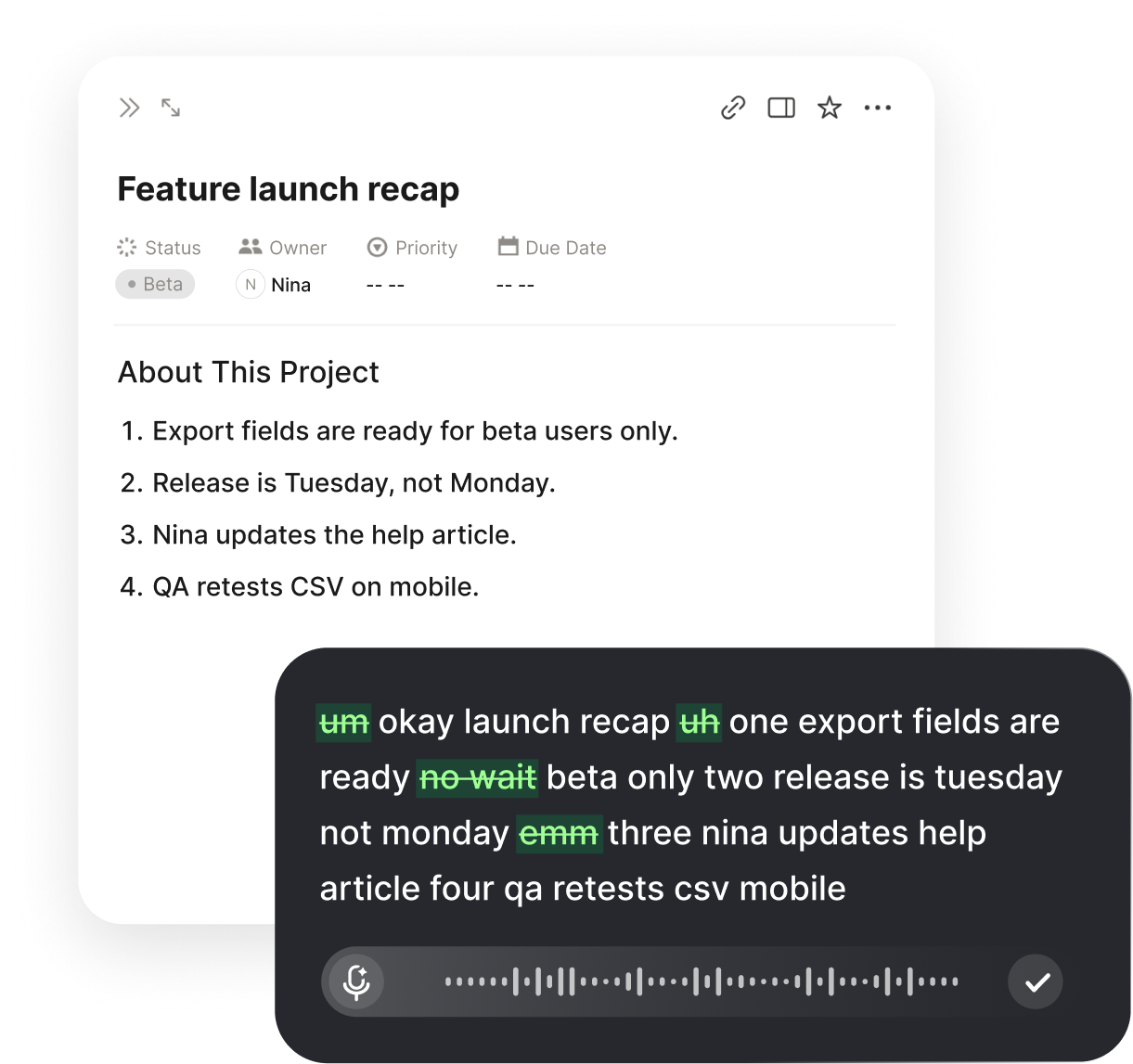
Why Action Items Disappear After the Meeting
Meeting action items disappear for three reasons: they were never written down, they were written without an owner, or they were written with a date that meant nothing. Most follow-up failures are note failures before they are discipline failures.
The discussion is where the energy is, so the action is often agreed in passing: someone says they will look into it, the meeting moves on, and the note records the topic rather than the commitment.
Even when the action is captured, it often lands in a paragraph. A sentence in the middle of a summary is easy to miss and hard to copy into a task tracker. The format determines whether the item survives.
The fix is to treat the action list as a separate artifact. It should be short, structured, and read back before the meeting ends. Everything else in the note supports it.
The cost is invisible because it is distributed. No single missed action looks dramatic, but a week of unowned commitments is a week of work that quietly does not happen.
A good action list also protects the meeting. When people know the list will be read back, they commit more carefully and interrupt vague promises before they enter the record.
The meeting note should make the action list impossible to miss. Put it at the end with a clear heading, and repeat the count in the summary: five actions, three owners. The repetition is not decoration; it is how a reader knows whether they are done.
Capture Commitments While People Are Still in the Room
Listen for commitments, not topics. A commitment has a verb, a person, and usually a time: I will send the draft by Wednesday, or we will test the flow before launch. Write those exact words.
Ask for the missing piece immediately. If someone commits without a date, ask when. If two people commit to the same thing, ask who owns it. A ten-second clarification in the meeting saves a week of ambiguity.
Do not wait for the end of the meeting to write the list. Capture commitments as they happen, then review the list at the end. Reconstructing actions from memory is where most items are lost.
If the meeting is recorded with permission, Voiskey can transcribe the audio and identify key topics, which helps you verify a commitment you half-heard. The recording supports the list; it does not replace the act of writing it.
If the meeting is a workshop or a brainstorm, distinguish an action from an idea. An idea is a possibility; an action is a commitment with an owner. The list should contain only the second.
Keep a parking lot for actions that belong to another meeting or another team. Mixing them into the current list creates owners who were never part of the conversation.
The list also needs a home. If action items live only in the meeting note, they compete with everything else in the document. A dedicated section, or a copy in the team's task view, gives the list a life beyond the meeting and makes the follow-up visible.
Write the action item from the perspective of the person who will do it, not the person who assigned it. Not send the draft but review the draft and send comments by Thursday. The rewrite forces the note to name the first concrete step, which is what the owner actually needs in order to start, and it exposes items that were only ever a wish.
Write Each Action Item in One Line
One line per action forces clarity. A good line has a verb, an object, an owner, and a date: Send updated pricing sheet to Jamie by Thursday. If it needs two lines, it is probably two actions.
Start with the verb. Pricing sheet is a topic; send the pricing sheet is an action. The verb tells the owner what to do and tells the next meeting what to check.
Avoid vague verbs such as review, look into, or align. They hide the real next step. If the work is genuinely exploratory, name the output: a one-page recommendation, a list of options, or a decision by Friday.
Keep the wording stable. If the action is copied into a task tracker, the owner should not have to reinterpret it. Plain language and one clause per item are enough.
Write the action so it can be checked. Done should be obvious to someone who was not in the room. Send the sheet is checkable; follow up is not.
If the action depends on a decision, record the decision next to the action. The owner then knows what is settled and what is still open, which prevents work based on a guess.
Assign One Owner per Item
One owner per item is the rule that makes follow-up possible. Shared ownership distributes credit and concentrates silence. If the work needs two people, name the accountable owner and note the collaborator.
The owner should be in the room when the item is assigned. An action assigned to an absent person is a guess about their priorities. If the person is not there, mark the item as proposed and confirm it before it enters the list.
Distinguish the owner from the reviewer. The owner does the work; the reviewer approves it. Both can be named, but only one is accountable for the deadline.
Read the owner list back at the end. People correct misattributions quickly when they hear their name attached to the wrong task. The correction is cheaper now than after the work starts.
If the same person owns most of the list, say so. An overloaded owner is a planning problem, and the note is the place where the imbalance becomes visible.
Name a backup only when the work would stop without one. A backup for every item creates ambiguity; a backup for a critical item prevents a stall.
The one-line rule is a quality check. If you cannot write the action in one line, you probably do not know what done looks like. Splitting the line forces you to name the next concrete step, which is exactly what the owner needs.
When an action changes owner, record the change rather than overwriting the original. The history shows whether the work is being handed off because of capacity, priority, or a misunderstanding, and that context is useful at the next review.
Keep a short log of action items that were closed and items that slipped, and review it at the start of the next meeting. The log turns follow-up from an accusation into a routine, and it shows whether deadlines are being set realistically. Two or three weeks of the log usually reveal a pattern that no single meeting could show.
Set Dates That Mean Something
A date is meaningful when it changes behavior. Soon does not; Thursday does. Choose the date based on when the next decision needs the output, not on an optimistic estimate of effort.
Use the next sync as a natural checkpoint. If the action is due before the next meeting, the item can be reviewed there. If it is due later, write the checkpoint date and the final date separately.
Mark blocked items explicitly. A date with a known dependency is different from a date with an unknown one. The note should say what the owner is waiting for, so the next meeting can unblock it rather than ask for a status.
Review dates at the start of the next meeting. Items that slipped get a new date and a reason; items that are done get closed. The review is what keeps the list credible.
Avoid dates that are really hopes. If the team does not know how long the work takes, set a date to estimate, not a date to finish. The first is honest and the second is fiction.
Put the date in the same format everywhere. A list that mixes Thursday, next week, and end of month is harder to review than a list with one convention.
Review the List at the Next Sync
Start the next meeting with the action list, not with new updates. This gives the list authority and prevents the meeting from becoming a series of fresh promises that nobody tracks.
Use three statuses: done, slipped, blocked. Done items are closed with one line of result. Slipped items get a new date and a cause. Blocked items get an owner for the unblock.
Keep the list in the same document as the previous meeting. A running list shows the history of commitments and makes patterns visible: which items repeatedly slip, which owners are overloaded, which dependencies are chronic.
Voiskey works across macOS, Windows, iOS, and Android. To capture the next meeting, open the official website and click the download button in the top right corner, then record with permission and build the list from the structured notes.
Keep the list visible between meetings. An action list that lives only in the meeting note is easy to forget; one that lives in the team's task view is part of the work.
Celebrate closed items briefly. A visible close is a small signal that commitments matter, and it makes the next list easier to fill.
Dates should be chosen with the owner, not for the owner. A date imposed from outside is a guess about capacity; a date agreed in the room is a commitment. The conversation takes thirty seconds and saves a week of slippage.
When an action item is blocked, record the blocker as part of the item instead of opening a separate note. A blocked item with a named dependency is still actionable; a blocked item without one is just a status. The next meeting can then start with the blockers rather than rediscovering them.
FAQ s
Voiskey turns meeting audio into structured notes that include decisions and action items with owners and deadlines.
No. You can record the meeting and review the action items in the structured notes afterward.
Action items in the structured notes carry an owner and a deadline, so each item can be checked against what was said in the meeting.
Voiskey is available on macOS, Windows, iOS, and Android.


 Voiskey
Your voice, amplified.
Download Voiskey for Mac or Windows and turn meeting audio into structured notes with decisions and action items.
Use it across macOS, Windows, iOS, and Android