
MEDDIC Sales Notes by Voice
Capture Clean MEDDIC Notes the Moment the Call Ends
The best qualification notes are the ones you capture before the next meeting pushes the last one out of your head. Speak your MEDDIC read the moment a call ends and Voiskey drops clean, structured notes straight into your CRM. Free to start.
The Deal Dies in the Gap After the Call
A discovery call ends, you have a clear read on the deal in your head, and then the next meeting starts in four minutes. By the time you come back to log it, the economic buyer's exact words have blurred, the metric the champion cared about is now something vague about cost, and the decision process you heard laid out step by step is a hazy memory. The qualification itself was good. The capture is what failed, and in MEDDIC a deal you cannot describe accurately is a deal you cannot forecast with any confidence.
Typing is the bottleneck. After back-to-back calls, nobody wants to sit and type six structured fields into Salesforce, so the notes get postponed, then shortened, then skipped. A keyboard runs at roughly 45 words a minute, and the detailed, specific notes that make MEDDIC worth doing are exactly the ones that take the longest to type. So reps compress. Budget confirmed replaces the actual sentence the buyer used, and the nuance that would have carried the deal review quietly disappears into a two-word summary nobody can defend.
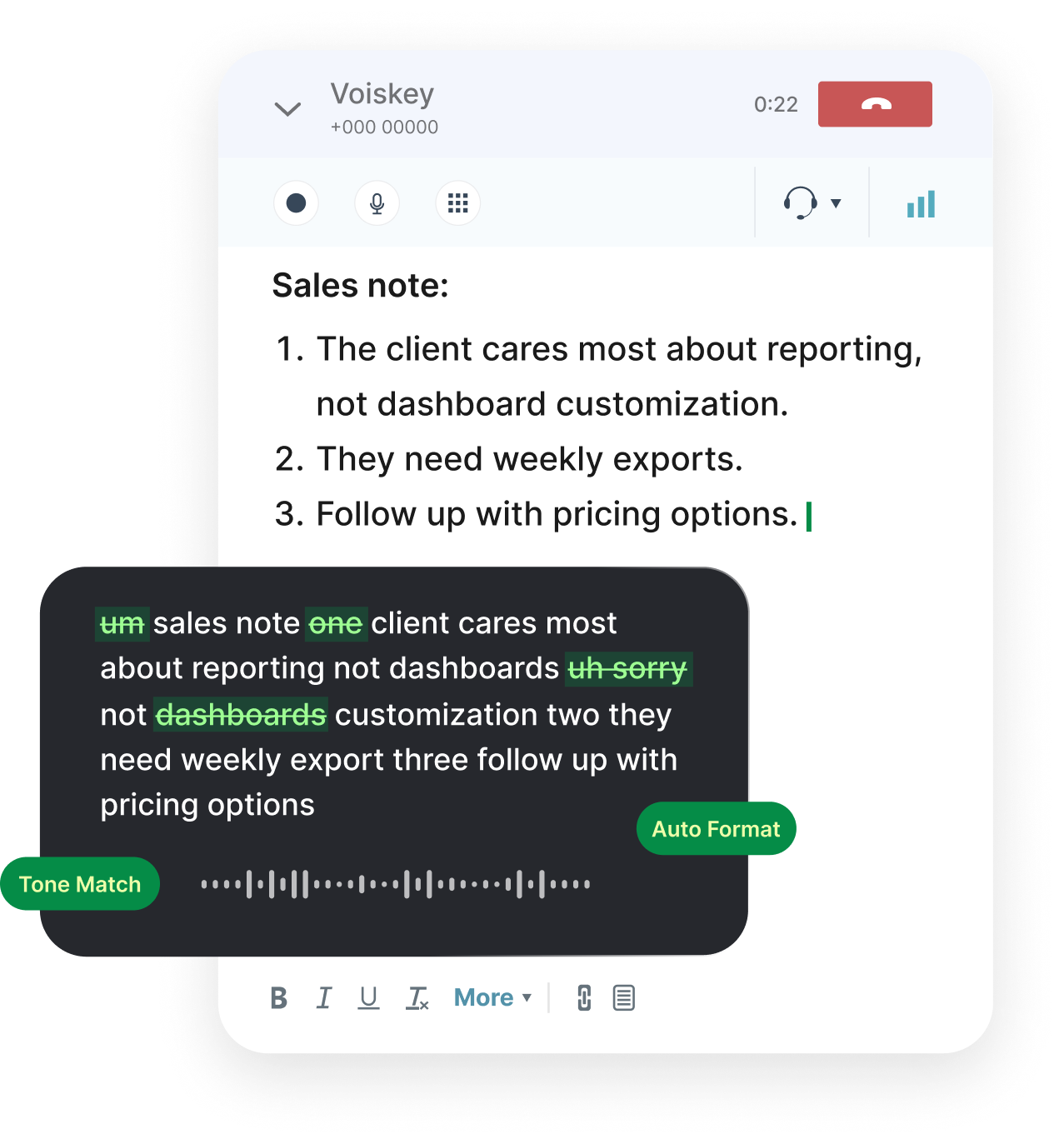
Speaking is closer to how you already think about a deal. You talk at around 220 words a minute, so you can narrate everything you learned on the call in the time it would take to type a single field by hand. Voiskey is a voice keyboard, so you can walk out of the room, open the opportunity, and simply say what happened. The metric, who controls the money, how they will decide, and the pain that is driving all of it come out while they are still sharp, in your own words, directly into the system you already use.
Where Reps Lose MEDDIC Detail
The gap between knowing and recording shows up at very specific moments in a sales week. Each one is a place where good qualification turns into thin notes, not because the rep is lazy, but because typing it properly costs more time than there is between meetings. A post-discovery debrief is the richest and most perishable; you walk out knowing the deal cold, and that knowledge has a shelf life measured in minutes. The stretch between back-to-back meetings is where last call's detail gets overwritten by this call's. A champion conversation carries exact phrasing you want verbatim, not paraphrased. And prepping a deal review is where you discover, too late, which fields were never really filled.
In every one of these, the detail is in your head the moment the conversation ends and mostly gone an hour later. Dictating closes that window. You speak the note while the call is still echoing, and the opportunity reflects what actually happened instead of a tidy reconstruction you assembled from memory the next morning. The scenarios below are the ones worth building a habit around, because they are exactly where typed notes tend to collapse into shorthand.
Where dictation saves the detail:
- Post-discovery debriefDictate the full MEDDIC read in two minutes
- Between back-to-back meetingsLog the last call before the next begins
- Logging a champion conversationCapture their exact words, not a paraphrase
- Prepping a deal reviewSpeak gaps and risks straight into the notes
How to Dictate MEDDIC Notes Step by Step
The trick is to let the framework itself be your script. You do not need to write polished prose on the call; you need to walk the six letters out loud, in order, right after it ends. Open the opportunity, put your cursor in the notes or description field, and talk through MEDDIC one letter at a time. Voiskey writes each line as you say it, so the structure comes from how you speak rather than from formatting you have to fight with afterward. The steps below map each spoken note to its MEDDIC field so nothing gets left out.
If your team runs MEDDPICC, add two more lines the same way: the Paper process, meaning the legal, procurement, and signature path, and the Competition, meaning who else they are evaluating and how you compare. The whole dictation takes two or three minutes, and because you spoke it in order, every field lands where it belongs instead of as one undifferentiated blob you have to untangle before the deal review. Over a few deals the pass becomes automatic, and you stop walking into pipeline meetings with fields marked to be determined.
Speak the deal, letter by letter:
- Metrics: say the number the buyer wants to move, in their words, for example, they want to cut onboarding time from six weeks to two and tie it to a renewal target.
- Economic buyer: name who signs and what you know about them, such as, the VP of Operations owns the budget, she has not been on a call yet, and the champion will introduce us next week.
- Decision criteria: dictate the specific things they will judge against, like, it must integrate with their existing stack, pass a security review, and show return on investment inside two quarters.
- Decision process: narrate the steps and dates you heard, for example, pilot in November, security review in December, and final sign-off at the January leadership meeting.
- Identify pain: speak the cost of doing nothing in concrete terms, such as, manual reconciliation is eating ten hours a week per analyst and causing month-end delays.
- Champion: capture who is selling for you internally and how committed they are, like, the operations lead has budget influence, has done this before, and offered to pitch it to the VP.
Jargon, Names, and Clean Field Notes
Sales notes are full of names, product terms, and acronyms, and that is exactly where typed shorthand goes wrong. Voiskey learns names and field-specific vocabulary, so your prospect's company, your champion's name, your own product modules, and terms like MEDDIC, annual recurring revenue, procurement, and net-new come out spelled consistently instead of being autocorrected into something you have to fix later. Say an unusual company or person name clearly once and check it; after that it keeps coming out right, which matters when the same account appears in note after note over a quarter-long deal.
Punctuation and editing stay out of your way too. You speak naturally and the text arrives with sentences and structure, so a dictated decision process reads as clean, separate lines rather than a single run-on. When you need to tweak a figure or a title before saving, it is plain text in the field you are already in, so you edit the one word and move on without reaching for a mouse or restructuring the note. The point is that the record is accurate and legible the first time, which is what makes it safe to forecast and brief a manager from. A note you trust is a note you will actually open before the next call.
Works in Salesforce, HubSpot, and Your Notes
Voiskey is a voice keyboard, so it works anywhere you can already type, with no integration to install and no admin to involve. That means you dictate straight into the Salesforce opportunity, the HubSpot deal record, a Gong or Chorus call note, your Notion deal room, or the Slack channel where your team tracks the account. The MEDDIC note goes directly into the system of record, not into a scratchpad you have to copy from later and inevitably forget to.
That matters because the real reason CRM data rots is friction. If logging a clean MEDDIC read means switching apps and typing, it slips to the end of the day and then to never. If it means talking for two minutes into the field that is already open in front of you, it actually happens after every call. Voiskey also picks up softer speech, including a whisper, so you can capture a note in an open-plan office, a shared workspace, or a quiet corner right after a meeting without broadcasting the state of the deal to the whole room.
Dictate into the tools you already use:
- Salesforce opportunity notesDictate MEDDIC into the field
- HubSpot deal recordsDictate MEDDIC into the field
- Deal room in NotionDictate the account summary
- Team updates in SlackDictate the post-call recap
Start Free Before Your Next Call
You get the same generous start everyone does: one month of Pro free when you create an account, up to two more months when you invite colleagues, and 2,000 words a week on the free plan after that, with no expiry. A two-minute MEDDIC dictation after each call fits comfortably inside that, and a full day of back-to-back discovery still leaves room to spare. There is no .edu address to supply and no verification to clear.
There is nothing to configure and no team rollout to wait for. Create an account, open your next opportunity, put your cursor in the notes field, and talk through the six letters the moment the call ends. The deal you just qualified will be documented accurately before the next one begins, and your pipeline will finally reflect what you actually know rather than what you had time to type. Speak the first one today and feel the difference by your next deal review.
FAQ s
MEDDIC is a B2B sales qualification framework covering Metrics, Economic buyer, Decision criteria, Decision process, Identify pain, and Champion. Some teams use MEDDPICC, which adds Paper process and Competition. It is a checklist for how well you actually understand a deal, and clean notes against each letter are what make it useful at forecast time.
Yes, that is the ideal moment. Open the opportunity, put your cursor in the notes field, and speak your MEDDIC read while the conversation is still fresh. Voiskey writes it straight into the CRM, so you capture the detail before the next meeting pushes it out of your head.
Voiskey learns names and field-specific vocabulary, so company names, your champion's name, and product terms come out spelled consistently. Say any unusual name clearly once and check it; after that it keeps writing it correctly across every note you dictate.
Yes. Voiskey works anywhere you can type, with no integration to set up, so you dictate directly into a Salesforce opportunity, a HubSpot deal, or any other CRM field. The note lands in your system of record instead of a separate document you have to copy over later.
Yes. Voiskey picks up softer speech, including a whisper, so you can capture a MEDDIC read quietly after a meeting without the whole floor hearing the deal. In a fully silent room, step aside for a moment and speak the note before the detail fades.
For most reps, yes. You get a month of Pro free, up to two more for inviting colleagues, and 2,000 words a week after that with no expiry. Short post-call MEDDIC dictations fit easily; heavy all-day dictation across long calls will use more.


 Voiskey
Your voice, amplified.
Speak naturally, write effortlessly, and move faster. Turn your voice into polished, ready-to-use text wherever you work.
Use it across macOS, Windows, iOS, and Android