
MEDDIC Checklist for Teams
The MEDDIC Checklist, Completed Without Typing
A pipeline is only as good as the meddic checklist behind each deal, and most are half-empty because typing full notes after every call is the first thing a busy rep skips. When the team dictates each field by voice instead, the checklist stays complete, forecasts hold up, and one-on-ones have something real to work from. Free to start.
Half-Empty Fields Break the Forecast
Walk any sales manager through their CRM and the same thing is true: the meddic checklist on most open deals is half-empty. Metrics are blank, the economic buyer is a guess, and 'decision process' just says 'Q3.' It is not that reps do not understand qualification. It is that typing a complete, specific note after every call is the first task that gets dropped when the day fills up, and a checklist full of gaps quietly becomes a forecast nobody can trust.
The cost shows up at the worst time. Deals that looked committed slip because no one had actually confirmed who signs the contract. Forecast calls run long because the data behind each stage is thin, so the team debates gut feel instead of reading the notes. New reps have nothing to learn from, because the records of your best deals are too sparse to coach against. The framework is fine; the hygiene is the problem, and hygiene fails whenever the easy thing and the right thing are not the same thing.
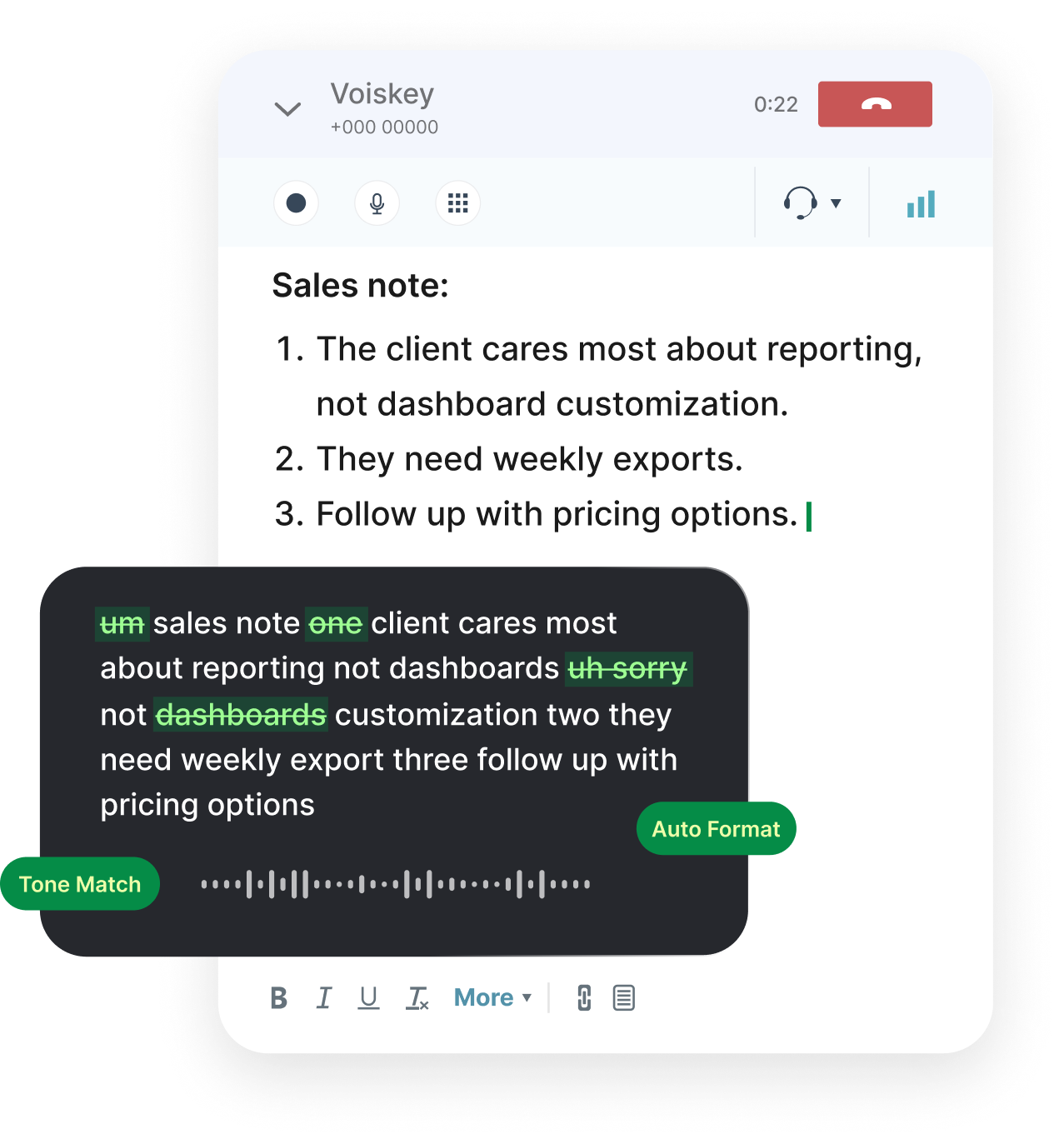
The fix is to make completing the fields cost almost nothing. Typing runs at about 45 words a minute, which is why it loses to a packed calendar. Speaking runs near 220, so a rep can narrate every MEDDIC field in the time it used to take to type one. Voiskey is a voice keyboard that turns that speech into clean text straight in the CRM, so a complete checklist becomes the default across the team instead of the exception a manager has to chase down every Monday.
Where Consistent Notes Change the Week
When every rep fills the checklist the same way, by voice, right after each call, the whole team's rhythm changes. The data is current because capturing it is faster than skipping it. Managers stop chasing updates and start reading them. The scenarios below are the recurring moments where consistent, spoken notes replace the usual scramble to reconstruct what happened before a meeting starts.
None of this requires a new process the team has to adopt. It is the process you already run, with the typing step removed. The deal reviews, the forecast calls, the onboarding, and the handoffs all get better simply because the underlying notes are complete and written in the rep's own words rather than compressed into whatever fit between back-to-back meetings on a heavy day. A manager who used to spend the first ten minutes of every review asking reps to explain what their own notes meant gets that time back, and the reps stop dreading the review because the record already defends the deal for them.
Where complete notes change the team's week:
- Monday forecast callEvery deal's fields already current
- One-on-one coachingReal notes to review, not blanks
- New-rep onboardingComplete deals to learn from
- Deal handoff between repsFull context, no gaps
How a Team Completes the MEDDIC Checklist by Voice
Standardize one spoken pass and have every rep run it after each meaningful call. Open the opportunity, put the cursor in the MEDDIC notes field, and go down the six fields in the same order every time so reviews are predictable and comparable across the team. Here is the field-by-field pass worth putting in your sales playbook, written so a new rep can follow it on day one and a veteran can run it in two minutes.
The team's standard spoken pass:
- Metrics: speak the quantified business outcome in the prospect's own numbers. 'They want support tickets down 30 percent this fiscal year.' A number everyone can see keeps forecast conversations honest instead of hopeful.
- Economic buyer: name who controls the budget and confirm whether it is confirmed or assumed. 'CFO approved, verified on the last call,' versus 'likely the CFO, not yet confirmed.' That one distinction drives the whole forecast.
- Decision criteria: dictate the exact criteria the buyer will score, in priority order. 'Must pass SOC 2 review, must integrate with their data warehouse, price is third.' This is the field coaching conversations are built on.
- Decision process: narrate the real stages, owners, and dates. 'Technical eval now, legal in two weeks, procurement signs in the first week of next month.' Vague timelines are exactly where slipped deals hide from the forecast.
- Identify pain: capture the cost of inaction in their words so it survives the handoff. 'Manual reporting eats two days a month per analyst and leadership still gets the numbers late.' Pain in their language keeps selling after the call.
- Champion: name the internal advocate and the proof they are selling for you. 'Priya built the business case herself and is presenting it to the CFO next week.' A named, tested champion is the field managers should probe hardest.
Notes a Manager Can Actually Read
Consistency only helps if the text is clean, and sales notes are dense with account names, competitor names, and acronyms. Voiskey learns the names and field-specific vocabulary your team uses, so account names and terms like MEDDIC, ARR, POC, and SOW come out spelled correctly after a few uses rather than needing constant correction. Say an unusual company name clearly once and it tends to stick, so the whole team's notes get cleaner instead of each rep fighting the same misspellings every week.
Punctuation and line breaks come through as the rep speaks, so a dictated checklist reads as scannable sentences and short lists instead of a run-on paragraph. That matters most on a forecast call, where a manager is reading twenty deals quickly and needs each field to stand on its own. Any mistake is fixed inline like a typo, so a rep spends seconds editing a near-complete note rather than minutes typing one from scratch, which is the whole reason the fields actually get filled.
Fits the Stack the Team Already Runs
Voiskey is a voice keyboard, so it works anywhere a rep can type, with no integration to configure and nothing for IT or RevOps to roll out. It drops text straight into a Salesforce or HubSpot opportunity, into the deal-review doc the team keeps in Google Docs or Notion, and into the Slack channel where pipeline updates get posted. There is no new system for anyone to log in to and no migration project to schedule before the team sees value.
It also matches how a distributed team actually works across devices. A rep captures a field on an iPhone leaving a customer site, a manager reviews it on a Mac before the forecast call, and the format stays identical the whole way through. Because Voiskey picks up softer speech, including a whisper, reps can dictate sensitive deal details in an open office or a customer's lobby without being overheard by anyone nearby.
Where the team dictates across the stack:
- CRM opportunity notesDictated field by field
- Deal-review documentsSpoken into Docs or Notion
- Pipeline updatesVoice typing in Slack
- Field capture after visitsDictated on mobile
Getting Started Is Free
Every rep gets the same start: one month of Pro free on signup, up to two more months for inviting colleagues, and 2,000 words a week on the free plan afterward with no expiry. A standardized field-by-field pass after each call is short enough to fit, which makes it an easy habit to roll out across a team before anyone has to decide on anything paid or involve a budget conversation.
There is nothing to integrate and no verification step to clear, so a team can try it on this week's deals without a procurement cycle. Have each rep create an account, open their live opportunities, and run the six fields out loud after the next round of calls. By the next forecast review, the pipeline reads like something you can actually forecast from, because every deal finally carries the detail that was always in the conversation but rarely made it into the record.
FAQ s
Forecasts are only as reliable as the fields behind each deal, and those fields go stale when typing them is a chore. Dictation makes completing every MEDDIC field fast enough that reps actually do it after each call, so the data a forecast rests on is current and specific rather than guessed at under deadline.
Yes. Standardize one spoken pass through the six fields in the same order and have every rep run it after calls. Because the notes come out as clean, consistent text, deal reviews read the same way for every rep and managers can compare deals at a glance instead of decoding each person's shorthand.
Voiskey is a voice keyboard that works anywhere you can type, so it drops notes straight into Salesforce, HubSpot, or any CRM field with no integration and nothing for RevOps to deploy. Reps put their cursor in the notes field and speak, and the text appears as if typed.
Complete, specific deal notes give you something real to coach from. Instead of blank fields, a manager and a new rep can review how a strong deal was actually qualified, in the customer's own language, which teaches what good looks like far better than a sparse record ever could.
It learns the names and vocabulary your team uses, so account names, competitor names, and terms like MEDDIC, ARR, and SOW come out spelled correctly after a few uses. Saying an unusual name clearly once helps it stick for later notes, which cuts down editing across the team.
Voiskey picks up softer speech, including a whisper, so reps can capture sensitive numbers or named buyers without the floor overhearing. The text appears in the field you chose, exactly as if you had typed it, so it stays inside your existing CRM access controls.


 Voiskey
Your voice, amplified.
Speak naturally, write effortlessly, and move faster. Turn your voice into polished, ready-to-use text wherever you work.
Use it across macOS, Windows, iOS, and Android