
Legal Dictation Software for Firms
Legal Dictation Software Built for Busy Law Firms
At most firms, legal dictation software means a per-seat suite with an IT project attached, so it never reaches the whole team. Voiskey is legal dictation software your firm can adopt in minutes, because it is a voice keyboard that works in every app your lawyers already use. Free to start.
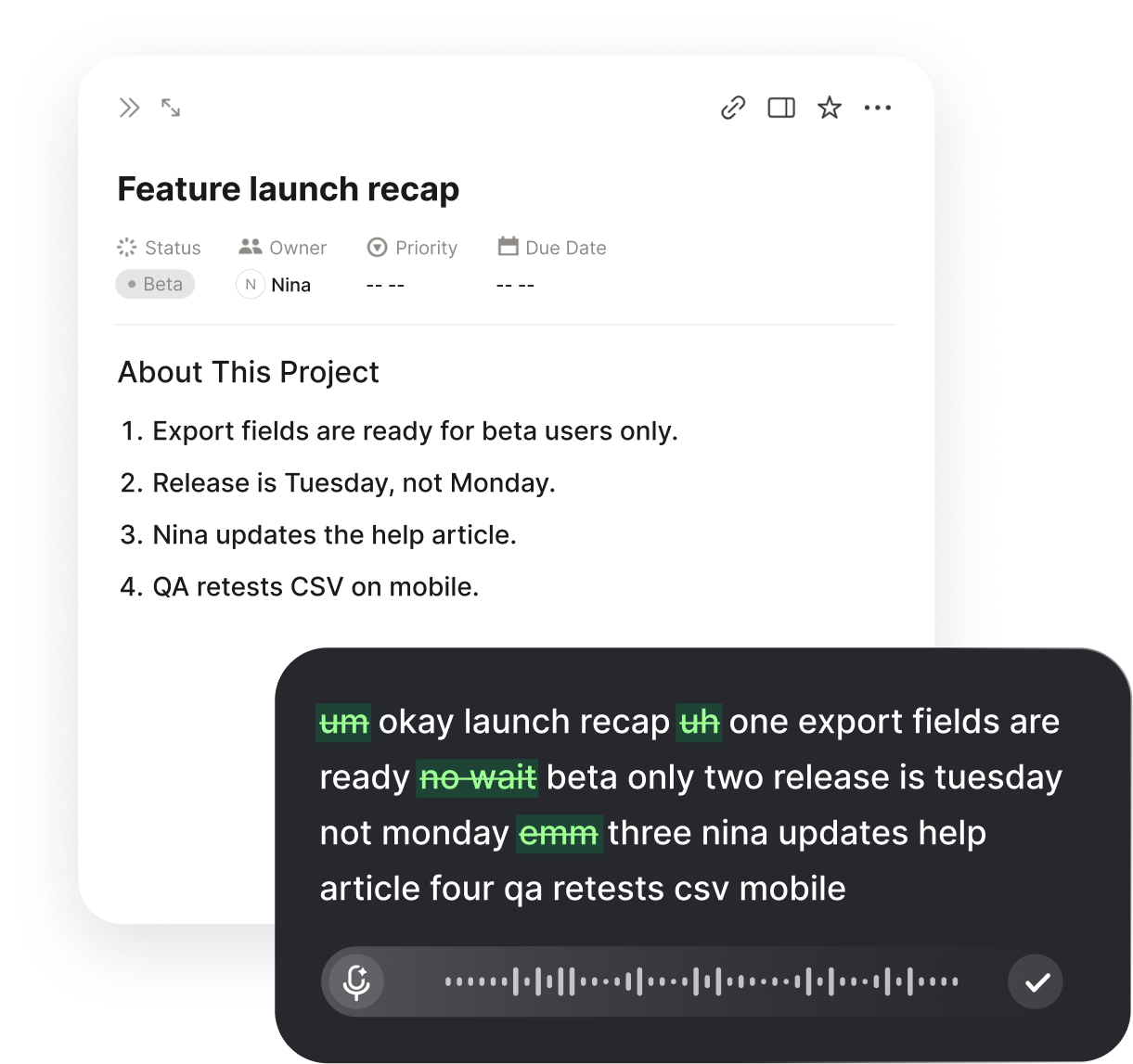
The Billable Time Typing Costs
For a law firm, legal dictation software is a billing question before it is a technology question. Every brief, memo, time entry, and client email that a lawyer types is produced at roughly 45 words a minute, and that pace sets a hard ceiling on how much a timekeeper can get through in a day. Multiply the drafting hours across a whole team of associates and partners and the firm is quietly paying for a lot of keyboard time that produces nothing a client wants to be billed for.
The deeper cost is the work that slips. When typing is slow, time entries get postponed to the end of the week and reconstructed from memory, which reliably undercounts the hours actually worked. Correspondence piles up, partners end up drafting at night, and the routine writing that fills a legal week expands to swallow the schedule. None of that is a thinking problem. The lawyers know what to say; the firm is losing hours purely in the gap between a finished thought and finished text.
Speaking removes that gap. At around 220 words a minute, a lawyer can say a paragraph in the time it takes to type a sentence, and the firm recovers the difference across every timekeeper, every day. The right legal dictation software does not lock that benefit inside one program; it lets everyone speak directly into the tools they already draft in, so the time saved shows up on real matters rather than in a demo.
Where Firms Save Hours
The savings are largest in the high-volume, repetitive writing that every practice generates, not just in the marquee briefs. These are the tasks that are easy to put off, quick to say out loud, and painful to type, which makes them the first place a team feels the change. When several lawyers reclaim this time at once, the hours add up fast at the firm level.
Because Voiskey works in any app, each of these scenarios happens in the tool where the work already lives, with no exporting or pasting in between. An associate dictates a research memo in Word, a partner clears correspondence from Outlook on the way to a hearing, and both log their time by voice in the case system without ever opening a separate dictation window. The compounding effect is what makes this a firm-level win rather than a personal productivity trick: when every timekeeper shaves time off the same recurring tasks, the recovered hours show up in capacity, in billing realization, and in how often people get to leave at a reasonable time.
Where the hours come back:
- Briefs and research memosFirst drafts out in a fraction of the time
- Time entriesCaptured contemporaneously, so billing improves
- Client correspondenceClear the inbox between meetings, not after hours
- Discovery and intake notesRecord detail while it is still fresh
How to Roll It Out to Your Team Step by Step
The appeal of this kind of tool for a firm is that there is no rollout in the traditional sense: no server, no connectors, no change-management project. The whole adoption plan fits on an index card, and a practice group can start on live matters the same afternoon. Here is the simplest way to get a team dictating.
Get the team started:
- Pick a pilot group, such as one practice area or a few associates and a partner, so you can measure the time saved on comparable work.
- Have each person create an account and start on the free month of Pro, with no license request or IT ticket needed.
- Point everyone at the apps they already draft in, Word, Outlook, Google Docs, and your case system, since the voice keyboard types directly into each one.
- Ask each lawyer to dictate one real task on day one, a memo, an email, or a batch of time entries, so the habit forms on actual billable work.
- Encourage the drafting-then-editing rhythm: speak the messy first pass, then clean it up, rather than trying to say a perfect sentence the first time.
- After a week, compare drafting time and time-entry completeness against the old baseline, then expand to the next group.
Accuracy Your Partners Trust
No partner will adopt a tool that forces a heavy proofreading tax, so accuracy on legal language is the make-or-break feature. Voiskey is built to handle technical terms and learns the names and field-specific vocabulary each lawyer uses most, which means client names, opposing firms, statutes, and recurring terms of art come out the way that lawyer writes them. Because learning is per account, each timekeeper's dictation gets sharper on their own book of business without anyone maintaining a shared firm dictionary.
Standard legal vocabulary, including common Latin phrases, is handled well from the start, and the practical workflow for anything high-stakes is the one careful drafters already follow. Speak the citation as parties and reporter, then glance at the text and confirm the volume and page before moving on. Treating each cite as a quick verify step keeps formatting dependable without slowing the draft, and it fits neatly into the review habits a firm already has.
The editing model also protects quality. Lawyers dictate the first pass while the reasoning is sharp and then make a dedicated editing pass by voice or keyboard, deleting, reordering, and tightening. Separating drafting from editing is how experienced writers have always worked, and it means the voice-typed draft that reaches a reviewing partner is a genuine first draft to refine, not raw transcript to untangle.
Fits Your Existing Stack
A firm should not have to rebuild its workflow around a dictation product, and with a voice keyboard it does not have to. Voiskey types wherever the cursor is, so it works across the full stack a legal team already relies on: Microsoft Word and Google Docs for drafting, Outlook and Gmail for correspondence, and the note, memo, and time-entry fields in whatever case management or CRM system the firm runs. There is nothing to integrate and nothing for IT to maintain, which is exactly why it can reach every lawyer rather than a privileged few.
It runs on Mac, iPhone, iPad, and Android, so a partner can dictate a reply from a phone between appearances and an associate can keep drafting on a tablet away from the desk. It also picks up softer speech, including a whisper, which matters in open-plan offices and shared workspaces where speaking at full volume about a matter is not an option. The firm gets one consistent way to turn voice into text everywhere its people actually work.
Fits the firm's everyday tools:
- Word and Google DocsBriefs, memos, and agreements
- Outlook and GmailClient and counsel correspondence
- Case management and CRMMatter notes and time entries
- Mobile for partners on the moveDraft between hearings and meetings
Getting Started Is Free
A firm can prove the value before committing a budget. Every account starts with one month of Pro free, up to two more months for inviting colleagues, and then 2,000 words a week free with no expiry, so a pilot group can run on real matters at no cost. That is enough to measure how much faster drafts come together and how much more complete the time entries look once the typing bottleneck is gone.
There is no verification step and no onboarding project standing between your team and the first dictated brief. Have the pilot group create accounts, open the documents and systems they already work in, and start speaking. The fastest way to know what typing is costing your firm is to watch a lawyer draft their next memo by voice and compare the clock.
FAQ s
No. Voiskey is a voice keyboard, not a server install or a system integration, so there is nothing for IT to provision and no connectors to configure. Each lawyer creates an account and starts dictating in the apps they already use, which means a team can be up and running the same day rather than after a quarter-long rollout.
Typing runs at about 45 words a minute while speaking runs at around 220, so the same brief, memo, or client email takes a fraction of the time to produce by voice. The minutes your associates and partners spend hunting for keys are minutes that could be billable or simply go home earlier. Faster drafting also makes contemporaneous time entries realistic, which improves capture.
Yes, because it types wherever your cursor is. If a lawyer can type a note, time entry, or memo into a field in your case management or CRM tool, they can dictate into that same field. There is no special integration to build, so it works with whatever system your firm already runs on.
Voiskey learns the names and field-specific vocabulary each person uses most, so individual accounts get sharper on the client names, matters, and terms of art each lawyer handles. There is no shared firm dictionary to maintain, which keeps setup effort at zero while still improving accuracy on the words that matter to each timekeeper.
Yes. Every account starts with one month of Pro free, up to two more months for inviting colleagues, and then 2,000 words a week free with no expiry. A practice group can pilot it on real matters at no cost and measure the time saved before anyone signs a purchase order.
It is aimed at the drafting lawyers do themselves, not at replacing a court reporter's certified record or a specialist transcription workflow. Think of it as removing the typing bottleneck from everyday briefs, correspondence, and time entries, so your team produces first drafts faster while your formal transcription processes stay exactly as they are.


 Voiskey
Your voice, amplified.
Speak naturally, write effortlessly, and move faster. Turn your voice into polished, ready-to-use text wherever you work.
Use it across macOS, Windows, iOS, and Android