
Productivity
How to Draft Cross-Timezone Email Updates Without Losing Your Voice
Send updates across timezones without rewriting yourself into a robot
Why Async Email Drains Your Voice
When your team spans three timezones, most of your communication happens in writing. That sounds manageable until you realize how much time you spend staring at a draft that technically says the right things but somehow doesn't sound like you.
The problem isn't the content. You know what you want to communicate. The problem is the translation layer — turning a thought in your head into typed words that land with the right weight and warmth. Speaking would take you 30 seconds. Typing and editing the same message takes five minutes.
For async-first teams, this friction compounds fast. Every status update, every blocker, every decision thread becomes a small writing project. By the end of the day, your emails are polished but hollow — correct but lifeless. The voice that makes your teammates trust you has been edited out.
The Rewrite Trap (and Why It Happens)
Here's the pattern most async workers fall into: you type a quick update, re-read it, and decide it sounds too casual. You rewrite it. Now it sounds too formal. You soften it. Now it's too long. You trim it. By the third pass, you've spent more time editing than the original thought warranted, and the message has drifted away from how you actually talk.
This happens because typing activates a different cognitive mode than speaking. When you speak, you're thinking out loud — natural rhythm, natural emphasis. When you type, you're composing and self-editing simultaneously. The inner editor kicks in before the first sentence is done.
Timezone gaps make this worse. You know your Singapore colleague will read this at 9am on Tuesday while you're writing it at 11pm on Monday. That awareness adds a layer of formality that wouldn't exist in a live conversation. You start writing for a hypothetical audience instead of the actual person who knows your voice.
Four Update Types That Travel Well
Not all async emails are the same. Before you open Voiskey, know which type you're sending — it determines the structure and tone that will land best for a reader starting their day in a different timezone.
Status Updates
Lead with the outcome, then context. What's done, what's blocked, what comes next. Readers get the headline first and dig deeper only if needed.
Decision Threads
State the decision or recommendation upfront. Support it with one to three sentences. Close with a clear next step or deadline — never bury the ask.
Blocker Escalations
Name the person, the information needed, and the timezone-specific deadline. Vague blockers create back-and-forth; specific ones get resolved before the next standup.
FYI Updates
Signal that no reply is needed. A simple "No action required" line at the top saves your reader from composing a reply they didn't need to write.
Speaking Into Voiskey: One Take, Right Tone
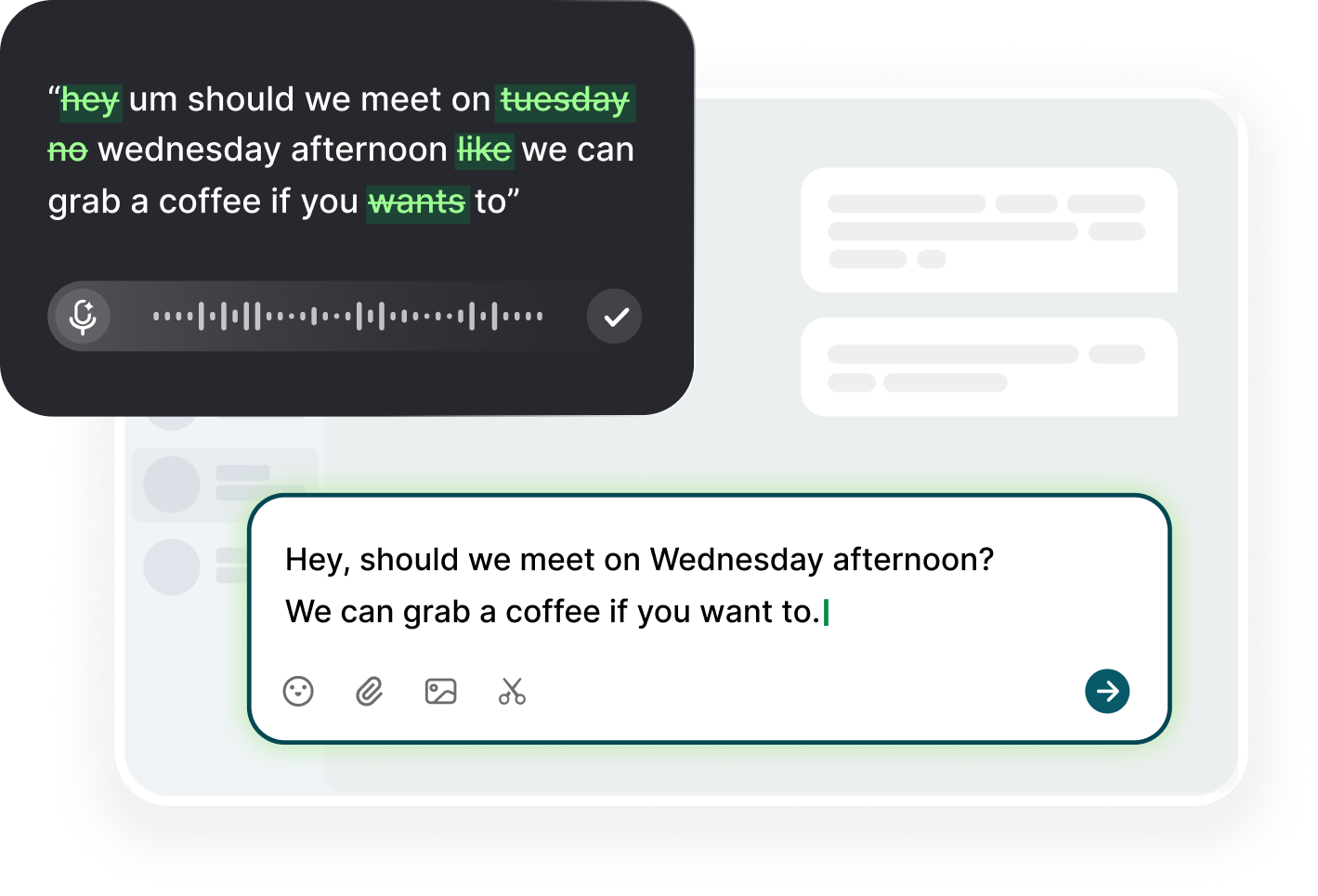
Voiskey's Expression Intelligence doesn't just transcribe what you say — it reads the context of where you're sending the message and calibrates the output accordingly. Speak into Voiskey with your email compose window open and your rough, spoken update becomes a clean, appropriately-toned email draft. The filler words disappear. The grammar tightens. The voice stays yours.
The key insight: you don't need to speak in email-ready prose. Say it the way you'd say it to a colleague standing next to you. "Hey, so the API issue from yesterday — we patched it this morning, staging looks clean, we should be fine to ship Thursday" becomes a well-structured status update without you touching the keyboard.
One take. Right tone. Ready to send. That's the workflow shift Voiskey makes possible for async teams — especially when the update needs to land well for a reader eight timezones away who's starting their day fresh while you're wrapping yours.
The Async Writer Checklist
Before you send any cross-timezone email update, run through this quick check: Does the subject line tell the reader what action (if any) is needed? Is the most important information in the first two sentences? Have you named the timezone when giving deadlines? Is it clear whether a reply is needed, and by when?
Most async communication failures aren't about tone or length — they're about missing context that would be obvious in a live conversation. Timezone-aware timestamps, explicit action items, and a clear "no reply needed" signal when the update is FYI-only — these small habits eliminate the back-and-forth that defeats the purpose of async work.
With Voiskey, drafting to this standard takes less time than the rewrite loop it replaces. Speak the update with these elements in mind, and the output lands ready to send — without the three editing passes that drain your voice before anyone even reads it.
FAQ s
Timezone gaps create an invisible formality pressure — you're writing for someone who isn't there yet, which makes you compose more carefully and self-consciously than you would in real time. The fix is to draft by speaking first, then let a tool like Voiskey handle the formatting so your natural tone survives into the final text.
Voiskey's Expression Intelligence detects the active application on your screen and calibrates the output accordingly. With an email compose window open, it formats your spoken input as professional correspondence — correct grammar, appropriate formality — rather than the casual style it would use for a Slack message.
No. You can speak in rough, conversational fragments and Voiskey will organize the output into coherent prose. The more naturally you speak — including fillers and restarts — the more accurately Expression Intelligence captures your actual intent.
Burying the headline. Async readers often skim on mobile before their day starts — if your most important information is in paragraph three, it may not get seen. Lead with the outcome or decision, then add supporting context.


 Voiskey
Your voice, amplified.
Speak naturally, write effortlessly, and move faster. Turn your voice into polished, ready-to-use text wherever you work.
Use it across macOS, Windows, iOS, and Android