
Voice to Text for Emailing Professors
Send the Email to Your Professor Without Overthinking It
You rewrite that email to your professor five times and still do not send it. Say what you actually need out loud and Voiskey drafts a clear, polite message you can review and send in about thirty seconds. Free to start.
The Email That Sits in Drafts
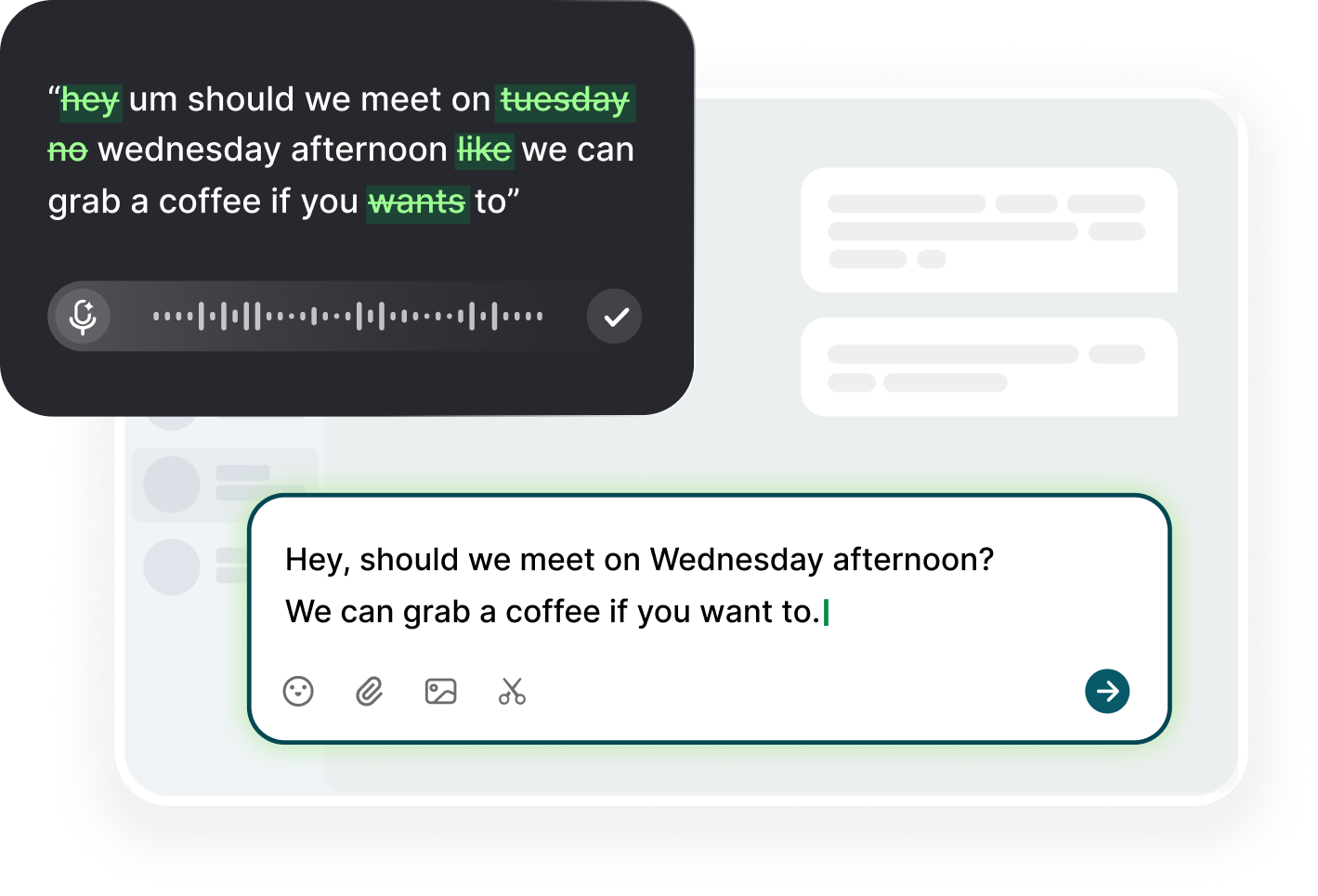
Emailing a professor triggers a rewrite spiral: too casual, then too formal, then too long, then deleted. So the message you have been meaning to send since Tuesday sits unsent while the deadline it is about keeps getting closer.
The strange part is you already know what you need. You could say it to them in office hours in one sentence. You just freeze when it has to be typed and permanent. Saying it out loud cuts through that paralysis, because a spoken sentence never feels like the final version.
The message you have been rewriting for three days takes about thirty seconds to say. Speak it, glance at the punctuation, and send.
What Students Dictate
Lecture notes
Voice to text for lectures works best in the gaps around class. Walk out and talk through what actually mattered while it is still fresh. There is no time limit on a session, so a three-hour seminar can come out in one go.
Essay drafts
Dictate an essay the way you would explain it to a friend who is not in your class. Say the messy version, then rearrange the text afterwards. The words are still yours. All you have changed is how they get onto the page.

Reading notes
Talk through a paper's argument as you go, instead of stopping to type a comment every time you have a thought.
Emails to professors and TAs
The message you have been rewriting since Tuesday takes about thirty seconds to say out loud.
Group projects
Updates, handoffs, and the message explaining what you meant in the last message.

Prompts for AI tools
A good prompt is longer than most people want to type, so it gets shortened into something vague. Say the whole thing instead.
A Clear Ask They Can Answer Fast
Professors read a lot of email, so the best message gives context and a specific ask in a few sentences. Speak your situation, your question, and what you are hoping for, then trim anything that is not essential during a quick review.
A rambling first pass is fine. Deleting two extra sentences takes seconds, and it is far faster than composing the whole thing from a cold start while second-guessing every word.
Speak the email in this order:
- Who you are and which class, in one line
- The situation or context, briefly
- The specific question or request
- A polite thanks and clear sign-off
Polite Without Being Stiff
Spoken language tends to be more natural and human than the over-formal wording students force when they type an email to someone they are nervous about. Dictate it the way you would respectfully talk to them in office hours, then tidy the greeting and punctuation before sending.
If English is not your first language, this matters even more. Say it in the language you think in and get clean English, so the email reads the way you mean it rather than the way you managed to spell it.
Right in Your Email Client
Voiskey works wherever you type, so dictate straight into Gmail or Outlook and edit an actual email instead of pasting from somewhere else. The same approach works for replies, follow-ups, and recommendation-letter requests you have been avoiding.
You can dictate quietly too. Voiskey picks up softer speech, including a whisper, so you can knock out an email in a shared study space without anyone hearing your business.
Emails students dictate most:
- Office hours or meeting requestVoice typing for emails
- Extension or deadline questionVoice typing for emails
- Recommendation letter askVoice typing for emails
- Follow-up after classVoice typing for emails
Getting Started Is Free
Short emails to professors fit easily in the free plan: one month of Pro free on signup, up to two more months for inviting friends, and 2,000 words a week after that with no expiry. The email you have been dreading costs you almost nothing to finally send.
No .edu address or enrolment check required. Open Gmail or Outlook, say what you need, and send the message that has been sitting in your head all week.
FAQ s
Yes, with a quick edit for the greeting and punctuation. Spoken drafts often read warmer and clearer than the over-formal, stilted wording students force when they type an email they are anxious about.
Say your reason honestly, the new date you are requesting, and your thanks. Keep it short. Professors appreciate a clear, specific ask far more than a long apology, and speaking keeps it concise.
Yes. Keep a saved draft, select the parts that change, and dictate the new details over them. Recurring emails become a ten-second job instead of a fresh agonizing rewrite each time.
That is fine for a first pass. Delete the extra sentences during your quick review; trimming a few lines is much faster than composing the whole email from scratch while second-guessing every word.
Speak in the language you think in and Voiskey returns clean English, so the email reads the way you mean it. It supports 100+ languages across 20+ keyboards.
Easily. Short emails to professors sit well within the free allowance, so this is one of the lowest-cost ways to use Voiskey day to day.


 Voiskey
Your voice, amplified.
Speak naturally, write effortlessly, and move faster. Turn your voice into polished, ready-to-use text wherever you work.
Use it across macOS, Windows, iOS, and Android