
Voice to Text for CS Students
Write the Report Around Your Code by Talking
The code was the fun part. Now you have to document it. Speak your approach and design choices and Voiskey drafts the write-up while you keep the keyboard for the actual code. Free to start.
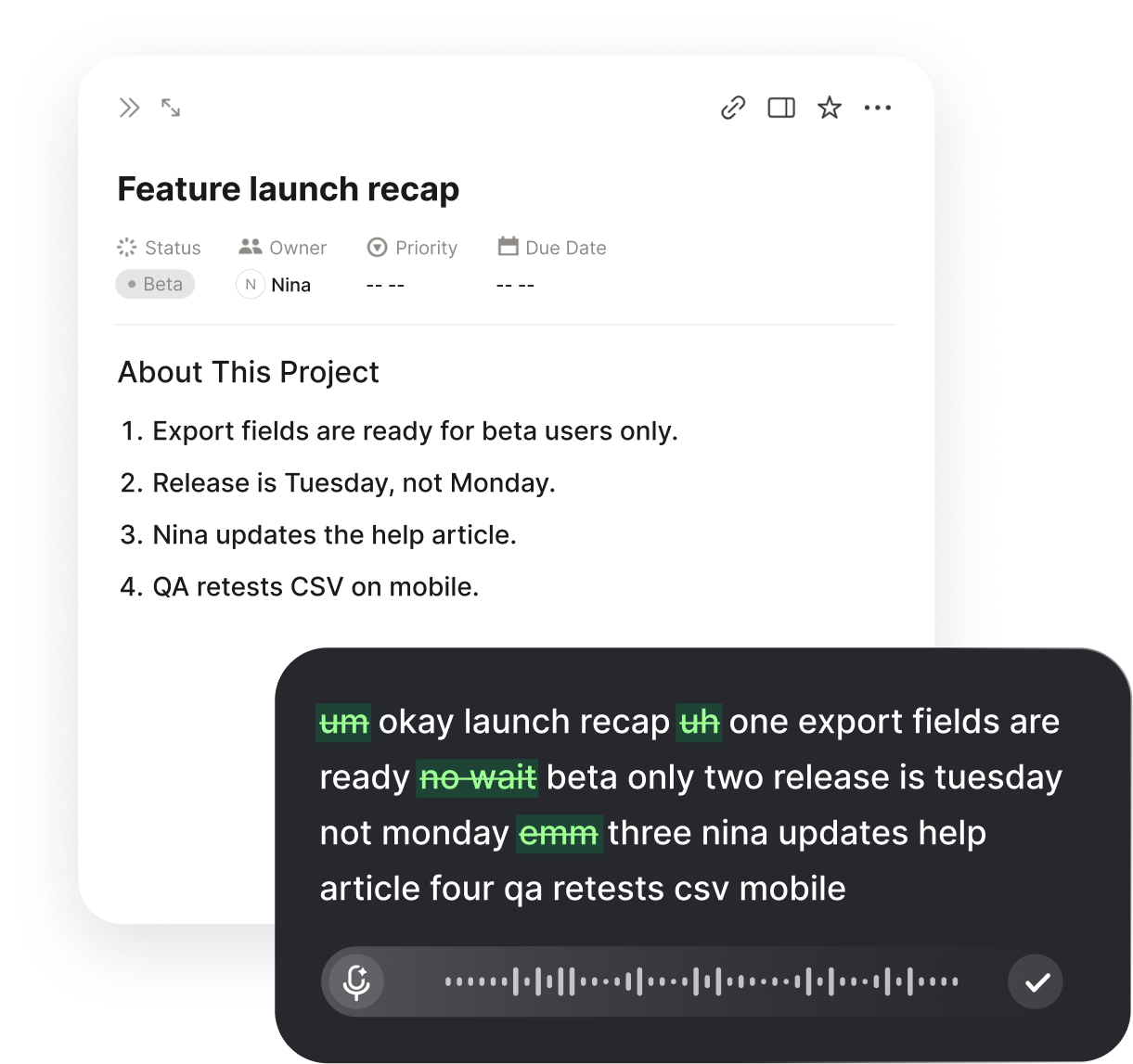
The Code Works, Now Explain It
For CS assignments, the code is usually the enjoyable part. Then comes the report, the README, and the design justification, written at the end when you are tired from debugging and the last thing you want is to type out paragraphs explaining what you already understand perfectly.
You can explain your approach out loud far faster than you can type it, especially in that state. Talk through why you chose a data structure the way you would explain it to a classmate, and you have a draft of the exact prose the grader is looking for.
Voiskey learns technical vocabulary, so terms come out spelled the way you mean them, and you keep the keyboard for the code itself.
What Students Dictate
Lecture notes
Voice to text for lectures works best in the gaps around class. Walk out and talk through what actually mattered while it is still fresh. There is no time limit on a session, so a three-hour seminar can come out in one go.
Essay drafts
Dictate an essay the way you would explain it to a friend who is not in your class. Say the messy version, then rearrange the text afterwards. The words are still yours. All you have changed is how they get onto the page.
Reading notes
Talk through a paper's argument as you go, instead of stopping to type a comment every time you have a thought.
Emails to professors and TAs
The message you have been rewriting since Tuesday takes about thirty seconds to say out loud.
Group projects
Updates, handoffs, and the message explaining what you meant in the last message.
Prompts for AI tools
A good prompt is longer than most people want to type, so it gets shortened into something vague. Say the whole thing instead.
Talk Through Your Design
Dictate why you chose a data structure, what trade-offs you made, and how the pieces fit together. Those are the exact things graders look for, and they are much easier to say than to type, because you are just narrating a decision you already made.
Speaking your reasoning also surfaces gaps in your own logic before you submit. If a design choice sounds shaky when you say it out loud, that is a cheap warning to fix it now rather than in the feedback.
Dictate the write-up as:
- What the program does, in one paragraph
- Your approach and key design choices
- Trade-offs and known limitations
- How to run it and test it
Voice for Prose, Keyboard for Code
Dictate the explanations, comments, and documentation, which are the natural-language parts, and type the actual code and syntax yourself. For inline comments, speak the intent of a function while your hands stay free for the symbols and identifiers, so the two never fight each other.
Say terms like "hash map" or "O of n" clearly and glance at the text; a quick edit fixes anything that lands wrong. Voice carries the reasoning, which is most of a report, and you keep full control over the code.
In Your Editor and Docs
Voiskey works in text fields across your system, so dictate into your README, a Markdown file, a Google Doc report, or a comment block right in your IDE, wherever the write-up needs to live. There is no separate app to paste from.
The same voice handles the email to your TA and the notes on bugs you want to fix later, so the whole non-code half of an assignment runs through one input method, even late at night in a shared space where a whisper is all you can manage.
CS write-ups you can speak:
- Assignment reportsVoice typing for documents
- README and docsVoice typing for documents
- Design and comment explanationsVoice typing for notes
- Emails to your TAVoice typing for emails
Getting Started Is Free
A report and README per assignment fit comfortably in the free plan: one month of Pro free on signup, up to two more months for inviting friends, and 2,000 words a week after that with no expiry. Documenting a large project over weeks uses more.
No .edu address or enrolment check needed. Open your README, explain what the program does in one breath, and let the write-up take shape while your head is still in the code.
FAQ s
Voice is best for the natural-language parts: reports, comments, and docs. Type the actual code and syntax by hand for accuracy, and let voice handle the prose that explains it, which is the slow part.
Voiskey learns technical vocabulary, so say terms like "hash map" or "O of n" clearly and check the text. A quick edit fixes any term that lands wrong, and it improves as it learns your usage.
Yes. It works in text fields across your system, including editors and doc tools, so you can dictate a comment block or a README right where you already are, with no context switch.
Yes. Explaining trade-offs out loud is often clearer than typing them, and it surfaces gaps in your reasoning before submission, when a shaky choice is still cheap to fix.
Yes. Voiskey picks up softer speech, including a whisper, so you can document a project in a shared apartment or lab at 1am without waking anyone.
A report and README per assignment usually fit. A month of Pro free, up to two more for inviting friends, then 2,000 words a week; documenting a large project over weeks uses more.


 Voiskey
Your voice, amplified.
Speak naturally, write effortlessly, and move faster. Turn your voice into polished, ready-to-use text wherever you work.
Use it across macOS, Windows, iOS, and Android