
Voice to Text for Code-Switching
Code-Switch Out Loud Without Breaking Translation
Real speech mixes languages. Dictation that panics at the mix slows you down. Speak naturally—Voiskey keeps the text usable. Free to start.
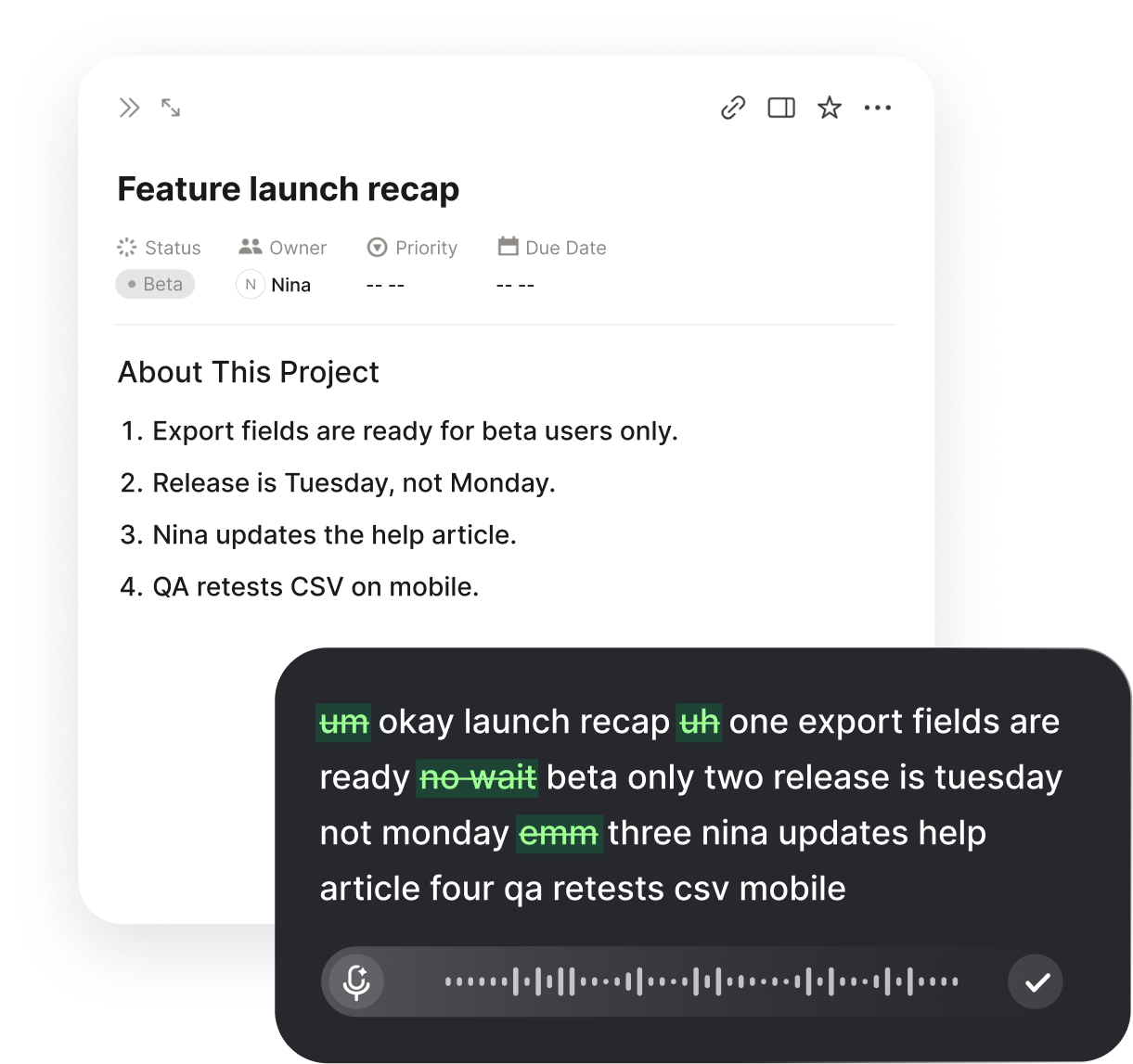
How Bilingual People Actually Speak
Offices that hire across cities do not speak in textbook monolingual paragraphs. A status update starts in English and finishes with a local phrase everyone already knows.
Typing forces you to pick one script and one keyboard. Speaking does not—so bad dictation tools punish the way teams actually talk.
Code-switching is not a bug in your workflow. It is the input. Translation is the optional output when the reader needs a single language.
Voiskey is built for that messy middle: understand the mix, then land text you can send, paste, or cleanly translate for the other side.
Detection Per Session, Not Per Word
Language is chosen at the start of a dictation session and held for that segment. Flip languages mid-sentence and the whole pass usually resolves to one language.
That design favors clarity over magic. If you need a different language, end the pass and start the next one—changes apply instantly, no restart.
Across 100+ languages, the practical move is a shortlist. Two languages you live in beat a wide net that guesses wrong.
English with Spanish, French, or German often behaves more calmly than English paired with Chinese or Japanese. Know your hard pair and simplify settings on those days.
Code-switching vs translation:
- Code-switching — you speak the blend you use with teammates
- Session language — one primary language for that spoken pass
- Translation output — reader-facing text in a single language
- Shortlist — 2–3 languages selected instead of full auto-detect
Where Code-Switching Shows Up at Work
Team Async Updates
Timezone notes that mix English terms with local status language.
Slack Decisions
The decision recap spoken the way the thread already sounds.
Support Replies
Customer language first, product terms in English when that is the house style.
Cross-Functional Notes
Engineering words in English, stakeholder narrative in another language.
Study and Reading Notes
Lecture language plus your own glosses—captured without switching keyboards.
Creative Outlines
Scripts and hooks that jump languages for rhythm, then settle for publishing.
Hinglish and Explicit Language Picks
Some blends are first-class options. Hinglish is not “Hindi plus English hope”—select it when that is your spoken mode so romanization and English formatting stay coherent.
Mutually exclusive pairs matter for translation-quality spelling: Hindi versus Hinglish, Simplified versus Traditional Chinese, German versus Swiss German, and the English regional variants.
Search the picker by English or native name. You should not need to remember which label hides the blend you speak at home.
Once the right option is on, code-switching stops being a fight with the keyboard and becomes ordinary dictation again.
Accuracy Tips When You Mix Languages
Prefer one dominant language per spoken pass. Drop in the other language for names, product terms, or a short phrase—not for alternating every clause.
If translation is the goal for the reader, finish the thought, then do a clean pass in the target language instead of forcing both jobs into one breath.
Teach stubborn terms once. Non-Latin scripts learn edits as real word changes, which helps vocabulary stick across 100+ languages without treating every fix like punctuation.
Whisper-friendly capture helps on open floors when the mix already makes you self-conscious. Softer speech still counts as input.
Workflows for bilingual days:
- Mixed-language personal and project notesVoice typing for notes
- Reader-facing email in one languageVoice typing for emails
- Chat that already code-switchesVoice typing for messages
- Team updates across language habitsVoice typing for teams
- Meeting notes in the room’s dominant mixVoice typing for meetings
FAQ s
Voiskey supports 100+ languages and works best when a session is mostly one language with occasional words from another. Rapid sentence-by-sentence switching is harder; a short selected list beats full auto-detect.
Select Hinglish explicitly when that is how you speak. Choosing only Hindi or only English often produces the wrong script or drops the blend you meant.
Chinese–English mixing is one of the harder pairs. Remove the language you are not using for that session, or dictate primarily in one language, then translate the finished paragraph if you need the other.
No. Code-switching is how you speak. Translation is how the reader receives a single clean language. You can do both: speak the mix, then ask for output that settles into one language for the audience.
Usually no. Manually selecting two or three languages is more reliable than asking the model to choose from the entire 100+ languages set on every utterance.


 Voiskey
Your voice, amplified.
Speak naturally, write effortlessly, and move faster. Turn your voice into polished, ready-to-use text wherever you work.
Use it across macOS, Windows, iOS, and Android