
Best Note Taker for Sales Calls and Client Follow-Ups
Sales notes only matter if they capture objections, owners, and next steps before the next call. A short voice-first note beats a long transcript.
 Voiskey Team
What Sales Notes Must Contain
A note taker for sales calls has a narrower job than a general note taker, and it is easier to judge because the output is testable. A sales note is good if the next person who reads it can answer four questions: what the client cares about, what was decided, who owns the next step, and when it happens. Everything else is optional.
Most sales calls produce enough material to fill several pages. The useful part is usually five sentences. The gap between those two amounts is the reason CRM notes are thin, follow-up emails are late, and handoffs lose context. Sales teams do not lack information. They lack a fast way to turn a conversation into a record.
This review focuses on that conversion step. We looked at how quickly a note taker captures the four questions, how well it handles client names and product terms, and whether the result can move into a CRM without a second editing pass.
Discovery calls and close calls need different notes. A discovery note is mostly about the client's words: the problem, the current workaround, the cost of the problem, and who feels it. A close call note is mostly about mechanics: the decision, the approver, the timeline, and the next step. Using the same template for both makes one of them weak.
Keep two templates, not one. The discovery template captures the client's problem in their words. The close template captures the decision and the mechanics. Switching templates is faster than adapting one generic form, because each prompts the right questions at the right moment.
Why Full Transcripts Do Not Close Deals
A sales note needs objections before it needs adjectives. The objection is the part of the call that predicts whether the deal moves. If the note only says the client was interested, it has recorded a mood, not a decision.
Stakeholders matter as much as objections. A note that says the client will discuss it internally is less useful than a note that names the person who has to approve it and the person who can block it. The same applies to next steps: a vague follow-up is a reminder that nobody owns.
Finally, a sales note needs a date. Not a relative one. A specific date turns a note into a commitment and makes the next call easier to prepare. If the date is unknown, the note should say that explicitly, because an unknown date is itself a finding.
Objections fall into a few categories: price, timing, authority, trust, and fit. Naming the category makes the next call easier, because each category has a different response. A note that records only the sentence misses the category, which is the part a manager or a successor needs.
Map each objection to a next action. Price objections need a value conversation. Timing objections need a trigger. Authority objections need the right stakeholder. When the note records the category, the next step becomes obvious, and the follow-up email writes itself.
The note should also capture what the client did not say. A missed follow-up, an unanswered question, or a stakeholder who was absent are all signals. Writing them down as open items turns silence into a next step, and that is often the difference between a note that records a call and a note that moves a deal.
Review Criteria for Sales Note Takers
Full transcripts fail sales teams for three reasons. The first is signal. A one-hour call produces thousands of words, and the objection is buried somewhere in the middle. Finding it takes time the rep does not have between calls.
The second is ownership. A transcript records what everyone said, but it does not assign a next step. Summaries are better, but they often flatten the objection into a neutral phrase, which is exactly the information the next call needs.
The third is workflow. A transcript lives in a meeting tool. The CRM lives somewhere else. The rep has to read, excerpt, and paste, which is the step that gets postponed. By Friday, the notes are a stack of unread dashboards, and the CRM is still empty.
Test the tool against the field you actually use. If your CRM has a notes field with a character limit, dictate into it and see how much cleanup is needed. A tool that produces three paragraphs for a field that holds five lines is not saving time, no matter how accurate the text is.
Test with a real call and a real CRM field. Dictate the note into the field you actually use, then check whether the structure survives the character limit. A note that fits the workflow is more valuable than a note that is technically perfect but cannot be stored where the team looks.
CRM Hygiene and the Ten-Minute Rule
The first criterion is capture speed after the call. A sales note written within ten minutes is a memory. A note written at the end of the day is a reconstruction. Voice capture is the fastest way to get the four questions on paper before the next meeting starts.
The second criterion is vocabulary. Client names, company names, product names, and pricing terms are where generic transcription fails. A personal dictionary is a sales tool, not a technical detail, because a misspelled account name makes the note hard to find later.
The third criterion is portability. The output should be plain text that can go into an email, a CRM field, or a shared document. A note that only exists inside a meeting tool creates another place to check and another reason to delay the CRM update.
The fourth criterion is consistency. The same four fields should appear in the same order every time. Structure is what makes a note scannable, and scannable notes are the ones that get read by the next person.
The ten-minute rule needs a trigger. Use the end of the call as the trigger, not the end of the day. Close the call, open the note, speak the four fields, and paste. If you wait for a free moment, the free moment arrives after the context has faded.
Make the ten-minute rule visible. Put a recurring calendar block right after your call-heavy periods, labeled only with the note you owe. The block gives the routine a place to happen and prevents the common failure where the next meeting starts before the note is written. Even five minutes is enough if the structure is already decided and the tool can keep up with speech.
A Post-Call Routine with Voiskey
The ten-minute rule is the core of CRM hygiene. For ten minutes after a call, the only job is to write the note. Not to research, not to reply, not to check the next meeting. The note captures the decision while it is still accurate.
With Voiskey, the routine is built for that window. Voiskey runs on Mac and Windows and types into whatever app has the cursor, so you can speak the four fields directly into your CRM, your email draft, or a project document. It does not join the call as a bot, which keeps client calls free of a visible recorder.
The speed difference is the reason the routine works. Typing a proper note takes several minutes and competes with the next meeting. Voiskey reports voice input above 220 words per minute, so the note takes under a minute to speak and a couple of minutes to clean. The app is free to start, and you can download it for your PC by opening the official website and clicking the download button in the top right corner.
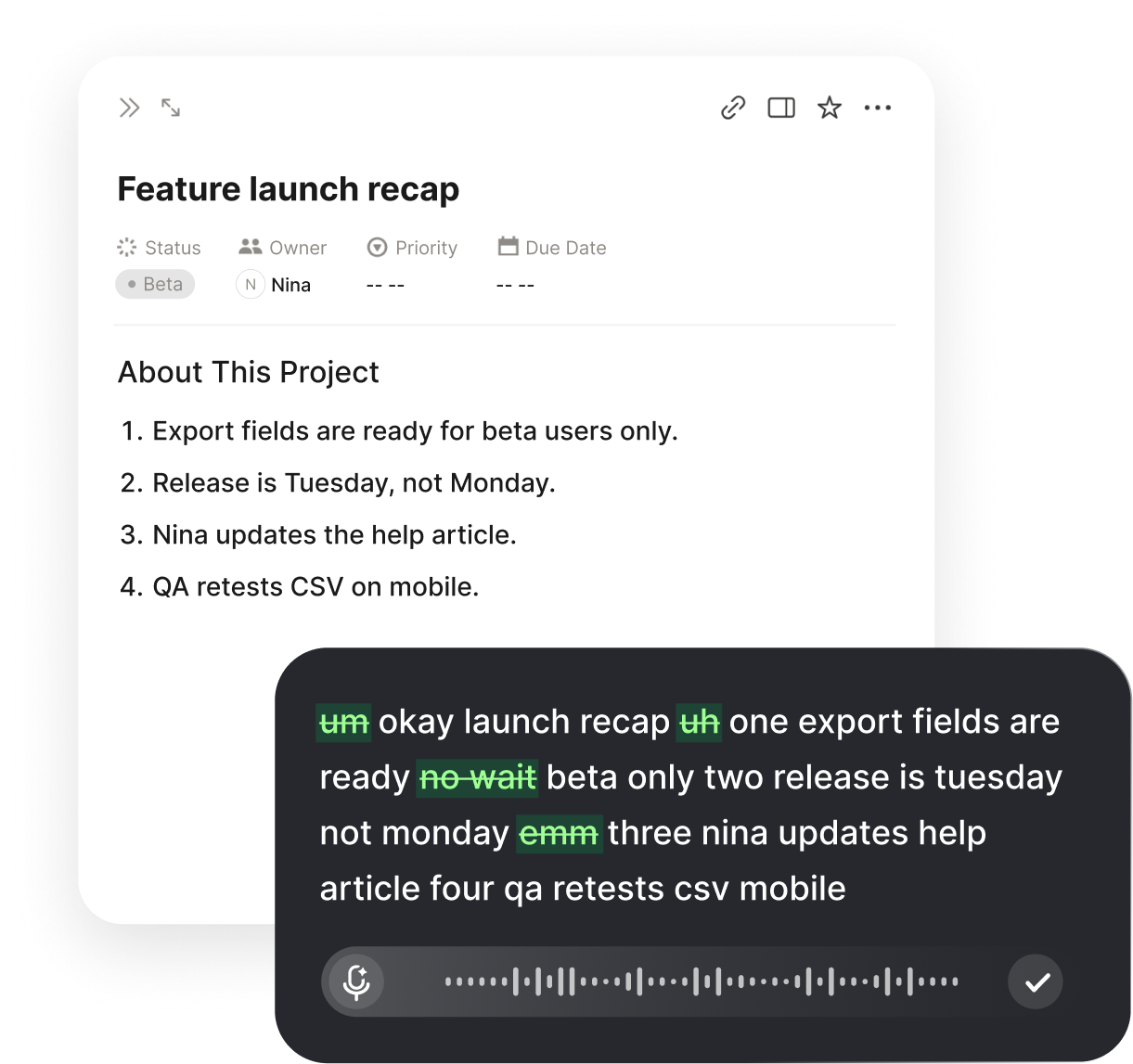
A spoken note can sound like this: decision, the client will run a three-week pilot with the operations team; owner, our solutions engineer; date, kickoff next Tuesday; open question, whether procurement needs a separate review. That is four sentences and it contains everything the next call needs.
Coaching and Handoffs
A structured note makes coaching possible. A manager can read ten notes in ten minutes and see the pattern: which objections appear, which next steps are vague, which stakeholders are missing. That is a much better use of review time than listening to call recordings.
Handoffs also improve. When an account moves to another rep or to customer success, the note is the context. A short note with objections, owners, and dates tells the next person what to ask about first. A transcript tells them where to start reading, which is not the same thing.
The last benefit is personal. A rep who writes the note immediately remembers the call better and prepares faster. The note is not just a record for the company. It is a tool for the next conversation, and the ten-minute rule is what keeps it useful.
Managers should review notes, not recordings. Ten notes take ten minutes and reveal patterns across the team: which objections recur, which next steps are vague, which stakeholders are missing. That review is more useful for coaching than listening to a single call in detail.
Run a weekly note audit instead of a weekly pipeline meeting. Pull ten recent call notes and check four things: objection, owner, date, next step. The gaps reveal coaching needs faster than a forecast discussion, and the fix is usually a template adjustment rather than a new tool.
A final test is whether the note can survive a handoff. Give it to someone who was not on the call and ask them what happens next. If they can answer without asking you, the note is complete. If they have to ask who owns the next step or when it is due, the template is missing a field, not the tool is missing a feature. Handoff readability is the simplest proof that a sales note did its job.
FAQ s
Speak the recap immediately after the call and let Voiskey type it into the email draft, document, or app field you already use.
No. Voiskey does not join the call as a participant; it captures your own voice and types into the app you are using.
Yes. Voiskey learns your names, jargon, and spelling preferences.
Voiskey voice input is rated at 220+ words per minute against a keyboard average of around 45, so a short recap takes far less time than typing it.


 Voiskey
Your voice, amplified.
Download Voiskey for Mac or Windows and speak your call notes directly into the CRM or email you are already using. Free to start.
Use it across macOS, Windows, iOS, and Android